The following letter was written by a Confederate prisoner of war being held at the recently completed prison camp at Elmira, New York. He signed his name J. W. Martin—a common name which makes it rather difficult to pinpoint his identity precisely. I found two soldiers by that name who may who may have written this this letter but I can’t be certain of either. One was named John Wesley Martin (1839-1921) and he belonged to Co. D of the 12th Georgia Infantry. He was taken prisoner at the Battle of Spotsylvania in May 1864 and was eventually placed at Elmira Prison camp after it became operational in July 1864. I cannot confirm when he arrived or left, however.
The second soldier was John W. Martin of Co. I, 18th North Carolina Infantry. He was taken a prisoner at Cold Harbor and was definitely held at Elmira over the winter of 1864-65. He was not released until 14 June 1865. If it was this J. W. Martin, he may have only survived because he received winter clothing from Mrs. Bestor. Whomever wrote the letter was an educated prisoner as the spelling and composition is remarkable for an enlisted man.
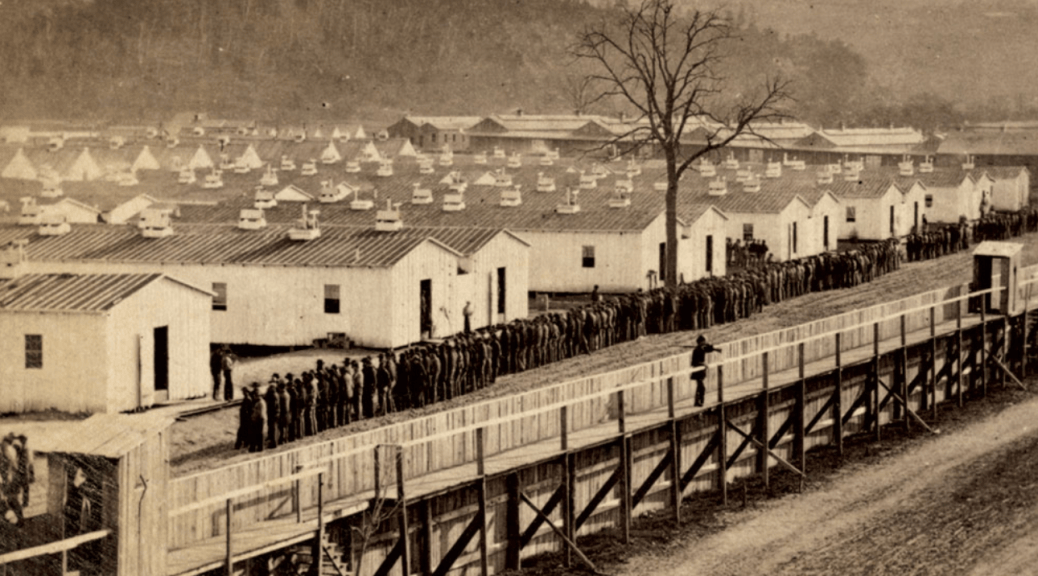
Elmira Prison did not open until early July 1864 and they quickly exceeded the design capacity of the camp. Many of the prisoners transported there were taken in the Overland Campaign in the middle of summer which meant they arrived with little extra clothing to protect themselves from the harsh Northern climate. Severe weather, poor drainage near the Chemung River, malnutrition, and disease led to nearly 3,000 deaths in its year of operation. Those confined there called it “Hellmira.”
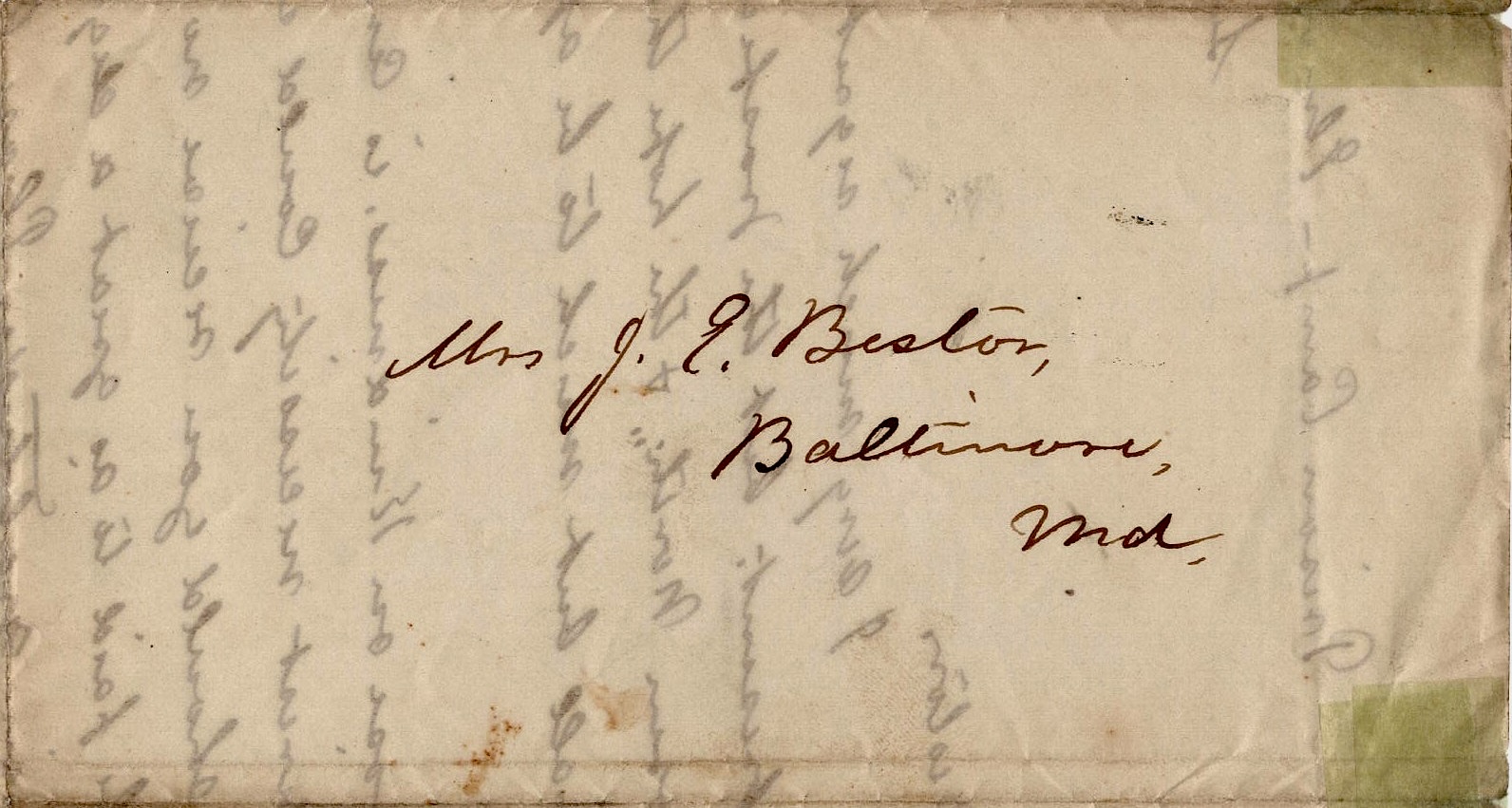
Martin wrote the letter to Jane Eliza (Brown) Bestor (1820-1885), the wife of John Rollin Bestor, Sr. (1813-1867). This Baltimore couple had twin sons who served in the Maryland Guard that became Co. B, 21st Virginia Infantry. Eliza seems to have corresponded with numerous Confederate officers and soldiers seeking information about her sons. It’s possible that Martin heard of Mrs. Bestor’s benevolence though he was a total stranger. Whether she assisted all who wrote her is unknown. The Bestor brothers’ letters have been transcribed and may be found at 1861-65: The Bestor Brothers of Baltimore.
T R A N S C R I P T I O N
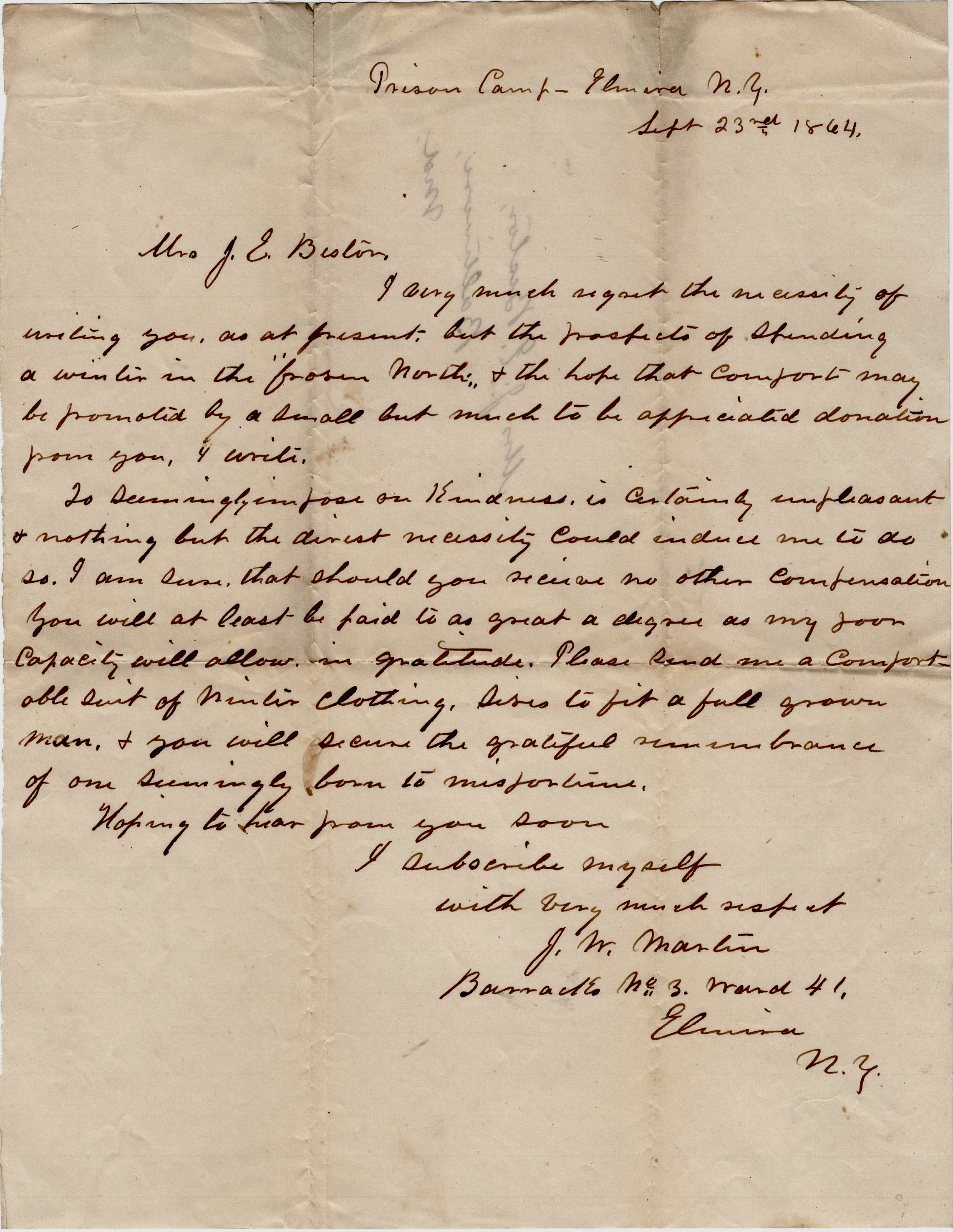
Prison Camp, Elmira, New York September 23rd 1864
Mr. J. E. Bestor
I very much regret the necessity of writing you, as at present, but the prospects of spending a winter in the “frozen North” & the hope that comfort may be promoted by a small but much to be appreciated donation from you, I write.
To seemingly impose on kindness is certainly unpleasant & nothing but the direst necessity could induce me to do so. I am sure that should you receive no other compensation, you will at least be paid to as great a degree as my poor capacity will allow in gratitude. Please send me a comfortable suit of winter clothing, sizes to fit a full grown man, & you will secure the grateful remembrance of one seemingly born to misfortune.
Hoping to hear from you soon, I subscribe myself, with very much respect, — J. W. Martin
The following letter was written by Dallas Fraker Paul (1845-1889) who enlisted on 6 August 1862 when he was 18 years old to serve three years in the 115th New York Infantry. He mustered in as a musician in Co. G on 20 August 1862 and in less than a month he was taken prisoner with most of his regiment when they were surrendered to Stonewall Jackson’s army at Harper’s Ferry. Like his comrades he was paroled and sent to Camp Douglass in Chicago to await his exchange. Dallas survived the war. He mustered out with his company on 17 June 1865 at Raleigh, North Carolina.
Dallas was the son of Philip Paul (1821-1856) and Catherine Baker (1821-1850) of Saratoga county, New York. He wrote the letter to his younger (17 year-old) brother, Addison Seymour Paul (1847-1934) who was recruited into Co. D, 95th New York Infantry. At the time this letter was written in late November 1864, the 95th N. Y. was serving in the 5th Army Corps while the 115th N. Y. was serving in the 10th Army Corps. Dallas’ letter describes returning from a visit to visit his brother during the Siege of Petersburg.
T R A N S C R I P T I O N
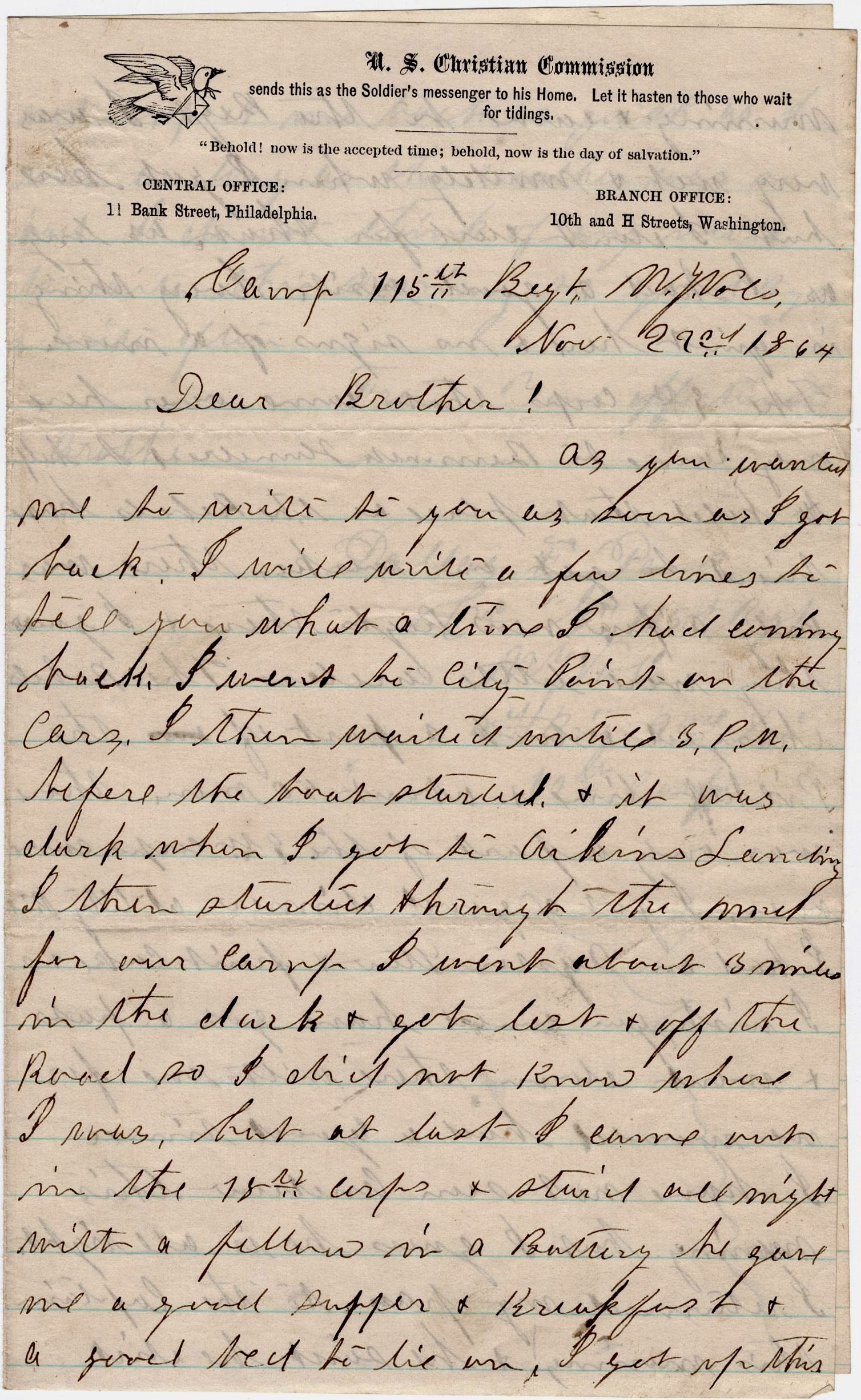
Camp 115th Regt. N. Y. Vols.
November 22nd 1864
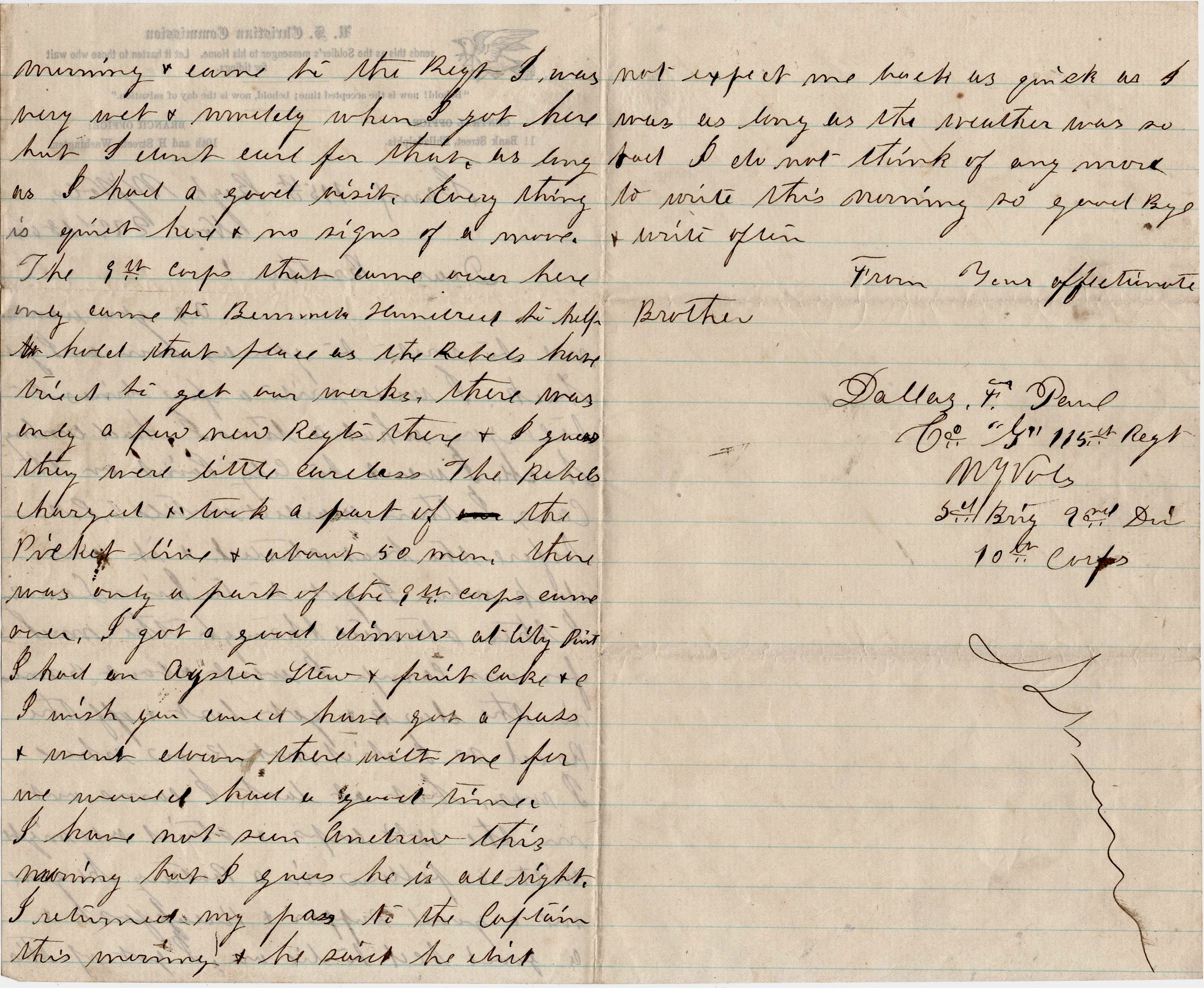
Dear Brother! As you wanted me to write to you as soon as I got back, I will write a few lines to tell you what a time I had coming back. I went to City Point on the cars. I then waited until 3 p.m. before the boat started & it was dark when I got to Aiken’s Landing. I then started through the mud for our camp. I went about 3 miles in the dark & got lost & off the road so I did not know where I was. But at last I came out in the 18th Corps & stayed all night with a fellow in a Battery. He gave me a good supper & breakfast & a good bed to lie on. I got up this morning & came to the regiment. I was very wet & muddy when I got here but I don’t care for that as long as I had a good visit.
Everything is quiet here & no signs of a move. The 9th Corps that came over here only came to Bermuda Hundred to help hold that place as the Rebels have tried to get our works. There was only a few new regiments there and I guess they were a little careless. The rebels charged and took a part of the picket line & about 50 men. There was only a part of the 9th Corps came over.
I got a good dinner at City Point. I had an oyster stew and fruit cake, &c. I wish you could have got a pass & went down there with me for we would had a good time. I have not seen Andrew this morning but I guess he is all right. I returned my pass to the Captain this morning & he said he did not expect me back as quick as I was as long as the weather was so bad.
I do not think of anymore to write this morning so goodbye & write often. From your affectionate brother, — Dallas F. Paul
Co. G, 115th Regt., New York Cols., 2nd Brigade, 2nd Division, 10th Corps.
The following letters were written by George Washington (“Wash”) Vosburgh who was 24 years old when he enlisted as a corporal in August 1862 at Canajoharie, New York, to serve three years in Co. K, 115th New York Infantry. He was promoted quartermaster-sergeant on January 1, 1864 and mustered out of the service on 24 June 1865 at Albany. His muster records state that Wash was a farmer by occupation and stood 5’5″ tall with dark hair, black eyes.
Wash and his comrades of the 115th New York had the misfortune of being among a handful of regiments that were at Harpers Ferry in September 1862 when Stonewall Jackson’s men descended on the town and were surrendered by poor leadership. They were scorned and mocked by the public as “Harper’s Ferry Cowards” even though they were poorly drilled and had barely been issued weapons. With few exceptions, most of the captured men were paroled and sent to Camp Douglas in Chicago to await their exchange. When they were returned to duty, they were sent to South Carolina to join the Department of the South but did not see any real action until 1864.
Seealso Wash Vosburgh papers, 1862-1866. Letters to his friend Ella describing his military experience, including service in coastal South Carolina and Florida and in the battle of Cold Harbor and siege of Petersburg. The collection also includes several letters written (1865-1866) from the oil fields of Titusville, Pa., where Vosburgh was a merchant. 1 linear ft. Located at Bentley Historical Library, University of Michigan.
Letter 1
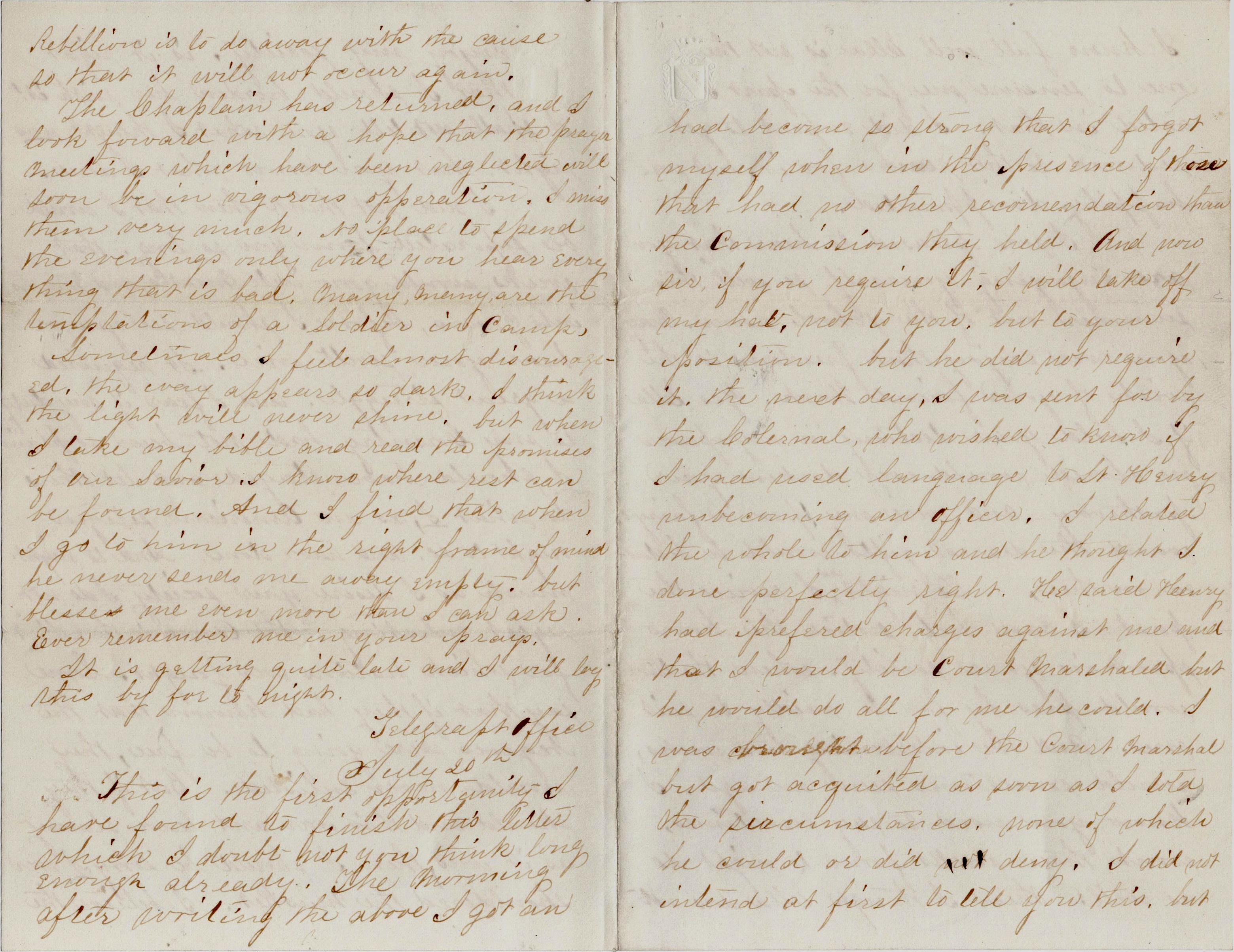
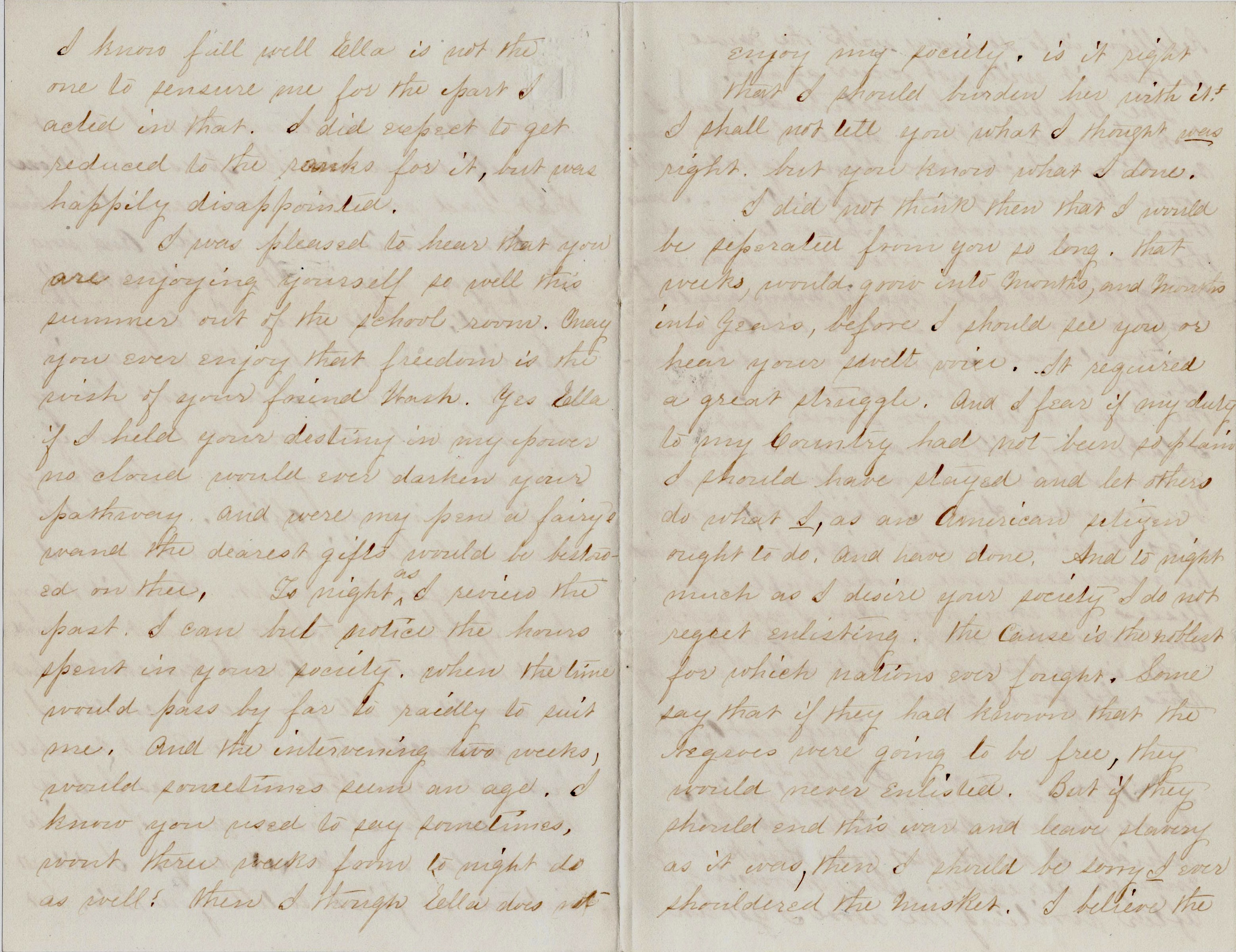
[Partial letter, July 1864] ….had become so strong that I forgot myself when in the presence of those that had no other recommendations than the commission they held. And now, sir, if you require it, I will take off my hat, not to you, but to your position. But he did not require it. The next day I was sent for by the Colonel who wished to know if I had used language to Lt. Henry unbecoming an officer. I related the whole to him and he thought I done perfectly right. He said Henry had preferred charges against me and that I would be court-martialed but he would do all for me he could. I was brought before the court-martial but got acquitted as soon as I told the circumstances, none of which he could or did deny. I did not intend at first to tell you this but I know full well Ella is not the one to censor me for the part I acted in that. I did expect to get reduced to the ranks for it, but was happily disappointed.
I was pleased to hear that you are enjoying yourself so well this summer out of the school room. May you ever enjoy that freedom is the wish of your friend Wash. Yes, Ella, if I held your destiny in my power, no cloud would ever darken your pathway. And were my pen a fairy’s wand, the dearest gifts would be bestowed on thee.
Tonight as I review the past, I can but notice the hours spent in your society when the time would pass by far too rapidly to suit me. And the intervening two weeks would sometimes seem an age. I know you used to say sometimes, “Won’t three weeks from tonight do as well?” Then I thought Ella does not enjoy my society. It is right that I should burden her with it? I shall not tell you what I thought was right, but you know what I done. I did not think then that I would be separated from you so long—that weeks would grow into months, and moths into years before I should see you or hear your sweet voice. It required a great struggle. And I fear if my duty to my Country had not been so plain, I should have stayed and let others do what I, as an American citizen, ought to do, and have done.
And tonight, much as I desire your society, I do not regret enlisting. The cause is the noblest for which nations are fought. Some say that if they had known that the Negroes were going to be free, they would never enlisted. But if they should end this war and leave slavery as it was, then I should be sorry I ever shouldered the musket. I believe the Rebellion is to do away with the cause so that it will not occur again.
The chaplain has returned and I look forward with a hope that the prayer meetings which have been neglected will soon be in vigorous operation. I miss them very much. No place to spend the evenings only where you hear everything that is bad. Many, many are the temptations of a soldier in camp. Sometimes I feel almost discouraged—the way appears so dark. I think the light will never shine. But when I take my bible and read the promises of our Savior, I know where rest can be found. And I find that when I go to Him in the right frame of mind, He never send me away empty, but blesses me even more than I can ask. Ever remember me in your prayers. It is getting quite late and I will lay this by for tonight.
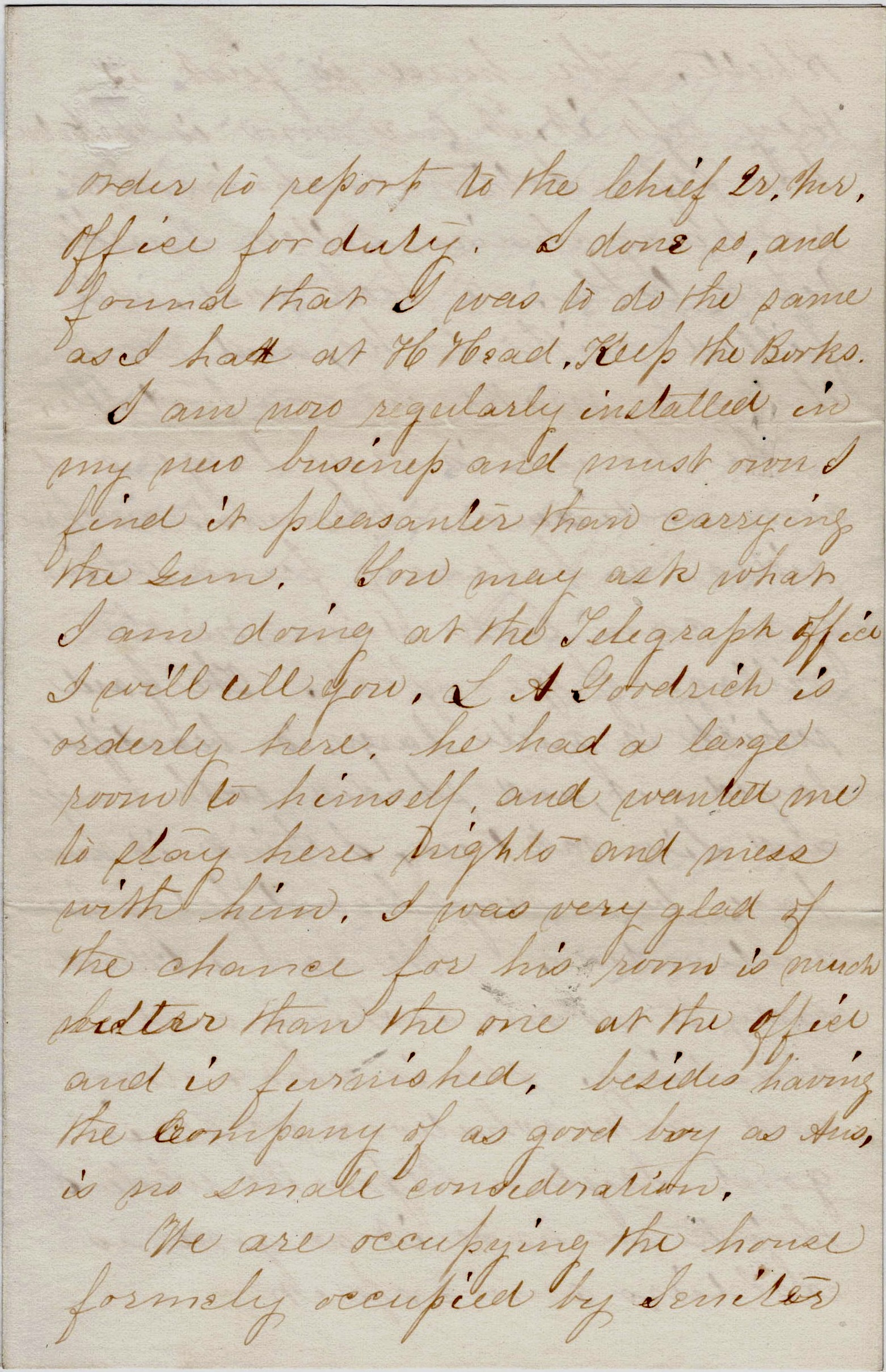
Telegraph office. July 20th. This is the first opportunity I have found to finish this letter which I doubt not you think long enough already. The morning after writing the above, I got an order to report to the Chief Quartermaster’s Office for duty. I done so and found that I was to do the same as I had at Hilton Head—keep the books.
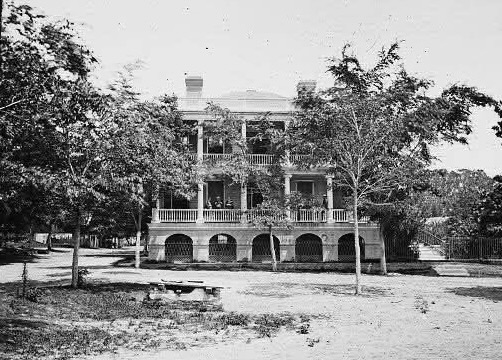
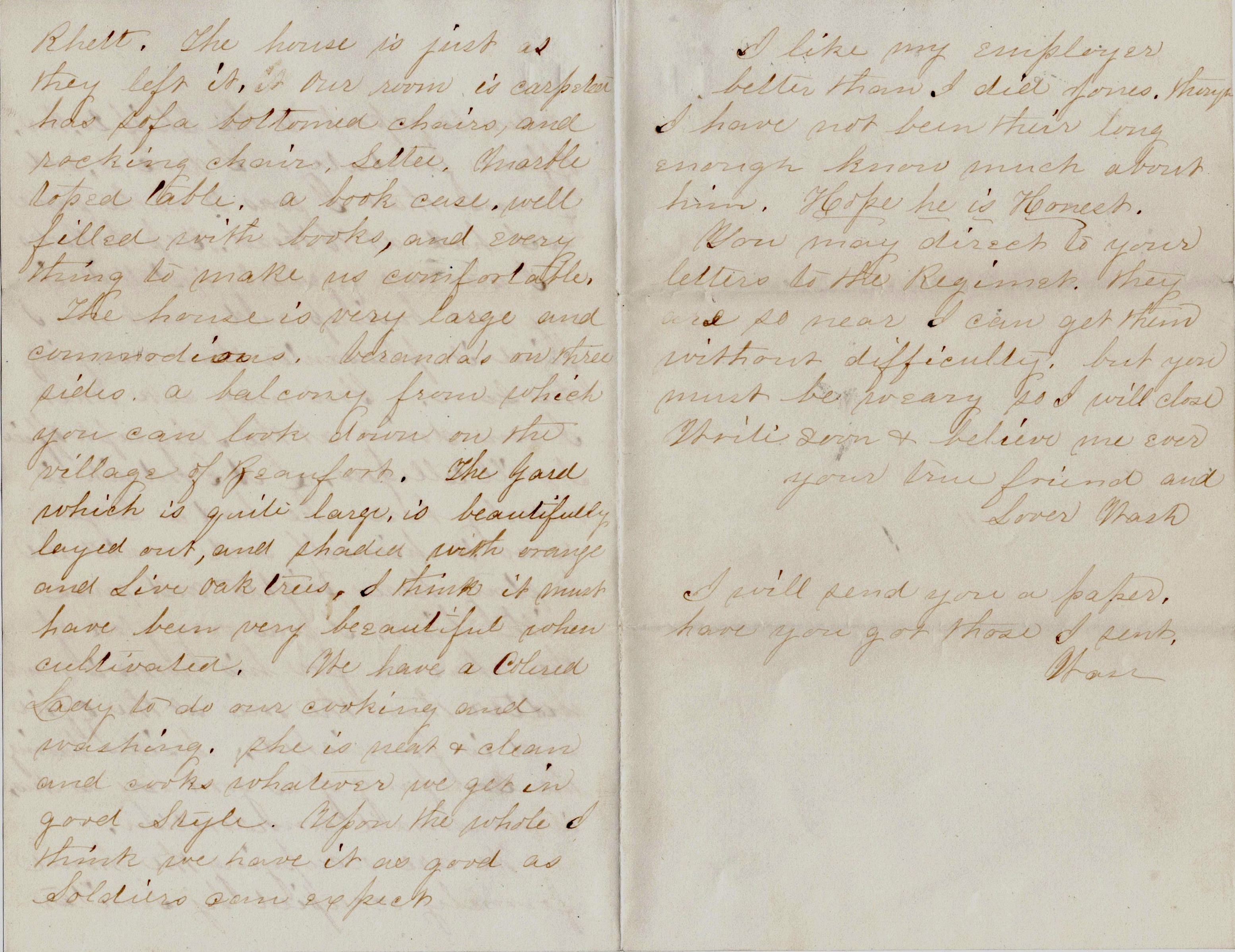
I am now regularly installed in my new business and must own I find it pleasanter than carrying the gun. You may ask what I am doing at the Telegraph Office. I will tell you. L[ewis] A. Goodrich is orderly here. He had a large room to himself and wanted me to stay here nights and mess with him. I was very glad of the chance for his room is much better than the one at the office and is furnished. Besides, having the company of as good boy as Aus is no small consideration. We are occupying the house formerly occupied by Senator [Edmund] Rhett. The house is just as they left it. Our room is carpeted, has sofa bottomed chairs, and rocking chairs, settee, marble topped table, a book case well filled with books, and everything to make us comfortable. The house is very large and commodious. Veranda’s on three sides, a balcony from which you can look down on the village of Beaufort. The yard which is quite large is beautifully laid out and shaded with orange and live oak trees. I think it must have been very beautiful when cultivated. We have a colored lady to do our cooking and washing. She is neat & clean and cooks whatever we get in good style. Upon the whole, I think we have it as good as soldier’s can expect.
I like my employer better than I did Jones though I have not been there long enough to know much about him. Hope he is honest.
You may direct your letters to the regiment. They are so near I can get them without difficulty but you must be weary so I will close. Write soon & believe me ever your true friend and lover, — Wash
I will send you a paper. Have you got those I sent? — Wash
The Rhett House in Beaufort, South Carolina. It was in the basement of this home where several South Carolina leaders vowed to secede from the Union if Lincoln was elected President of the United States.
Letter 2
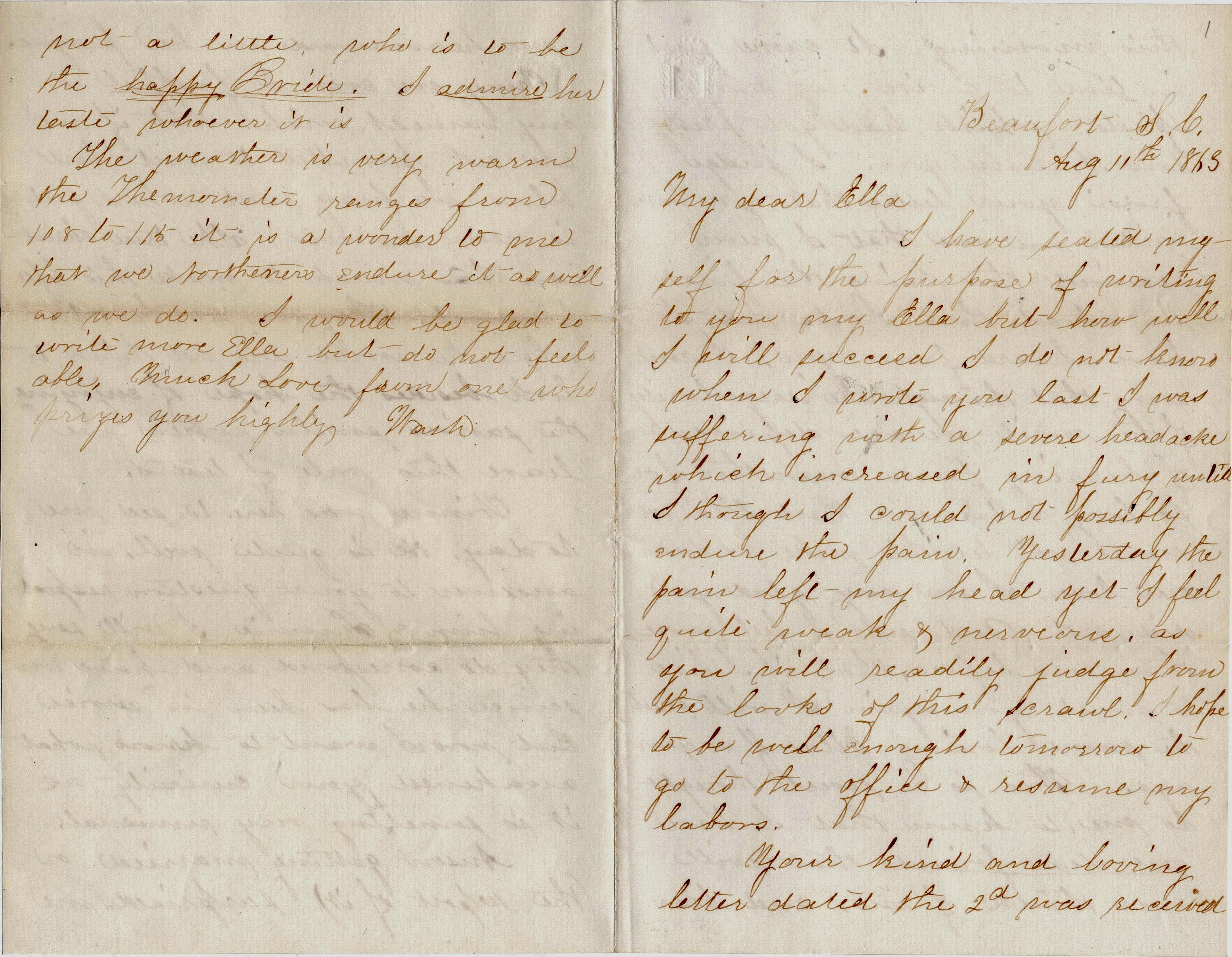
Beaufort, South Carolina August 11, 1863
My dear Ella,
I have seated myself for the purpose of writing to you my Ella but how well I will succeed I do not know. When I wrote you last, I was suffering with a severe headache which increased in fury until I thought I could not possibly endure the pain. Yesterday the pain left my head yet I feel quite weak & nervous as you will readily judge from the looks of this scrawl. I hope to be well enough tomorrow to go to the office & resume my labors.
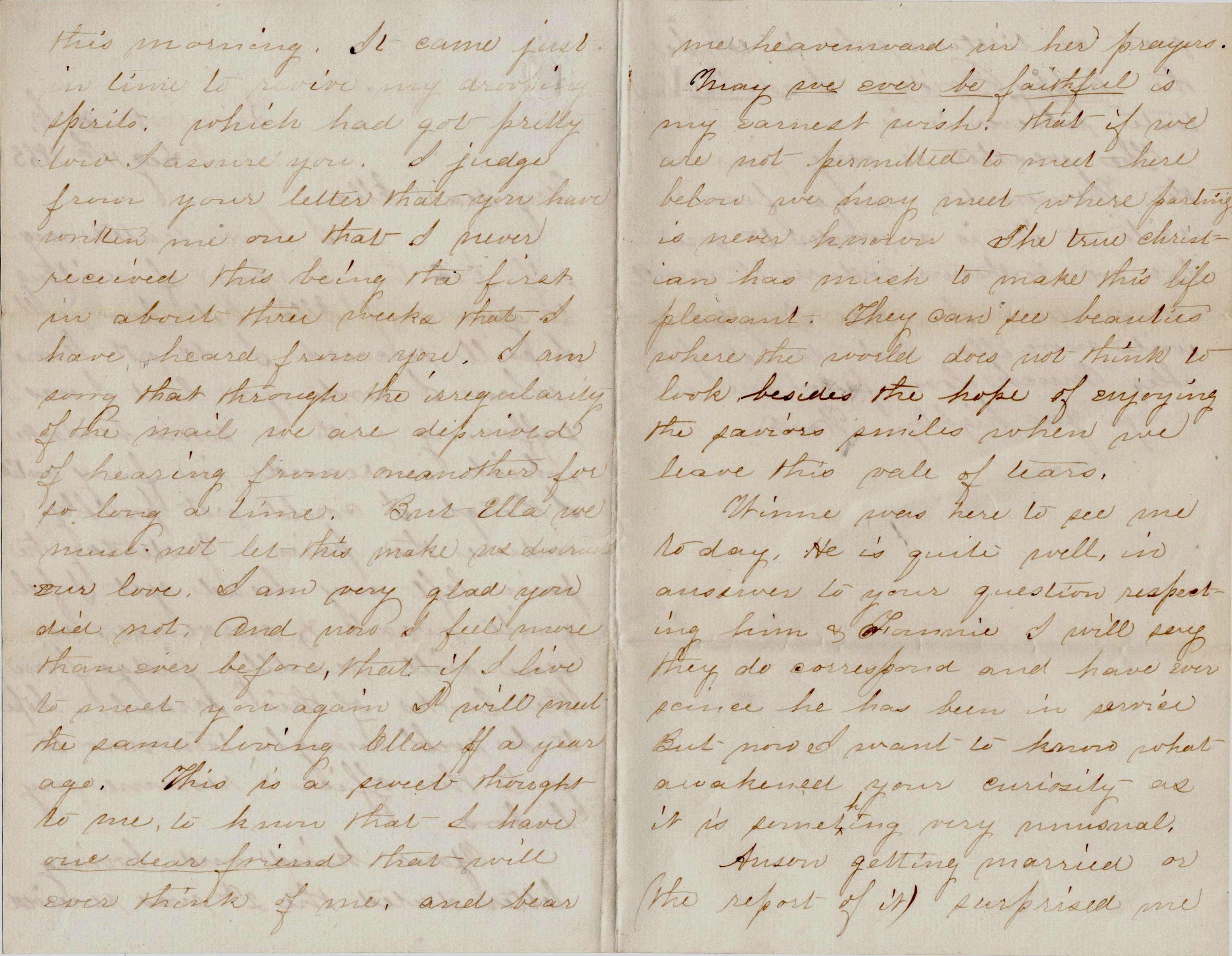
Your kind and loving letter dated the 2nd was received this morning. It came just in time to revive my drooping spirits which had got pretty low, I assure you. I judge from your letter that you have written me one that I never received, this being the first in about three weeks that I have heard from you. I am sorry that through the irregularity of the mail we are deprived of hearing from one another for so long a time. But Ella, we must not let this make is distrust our love. I am very glad you did not. And now I feel more than ever before that if I live to meet you again, I will meet the same, loving Ella of a year ago. This is the sweet thought to me—to know that I have one dear friend that will ever think of me and bear me heavenward in her prayers. May we ever be faithful is my warmest wish. that if we are not permitted to meet here below, we may meet where parting is never known. The true Christian has much to make this life pleasant. They can see beauties where the world does not think to look, besides the hope of enjoying the Savior’s smiles when we leave this vale of tears.
Winne was here to see me today. He is quite well, in answer to your question respecting him, & Fannie, I will say they do correspond and have ever since he has been in service. But now I want to know what awakened your curiosity as it is something very unusual. Anson getting married (or the report of it) surprised me not a little. Who is to be the happy bride? I admire her taste, whoever it is.
The weather is very warm. The thermometer ranges from 108 to 115. It is a wonder to me that we Northerners endure it as well as we do, I would be glad to write more, Ella, but do not feel able. Much love from one who prizes you highly, — Wash
Letter 3
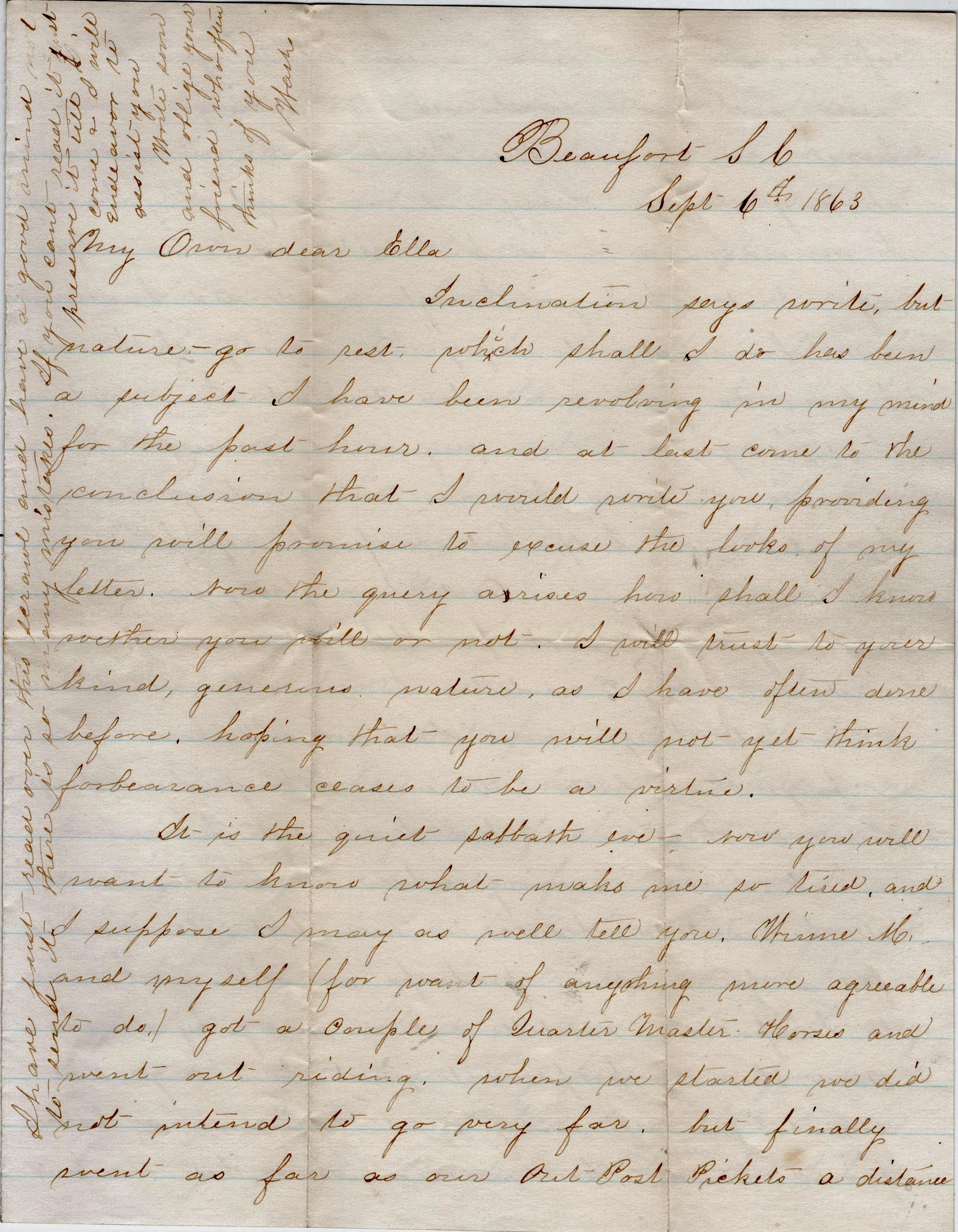
Beaufort, South Carolina September 6th 1863
My own dear Ella,
Inclination says write, but nature go to rest. Which shall I do has been a subject I have been revolving in my mind for the past hour and at last come to the conclusion that I would write you providing you will promise to excuse the looks of my letter. Now the query arises, how shall I know whether you will or not. I will trust to your kind, generous nature as I have often done before, hoping that you wil not yet think forbearance ceases to be a virtue.
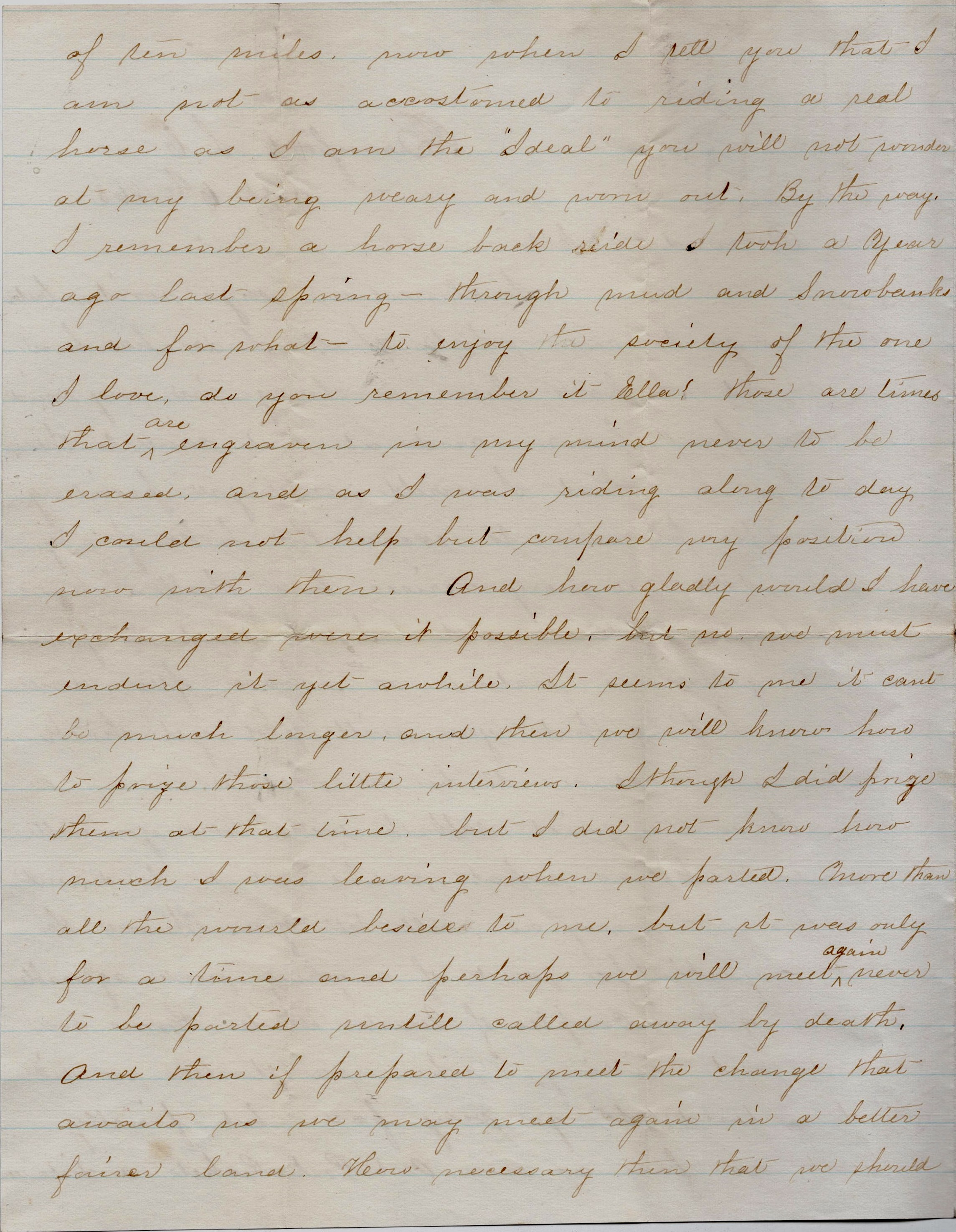
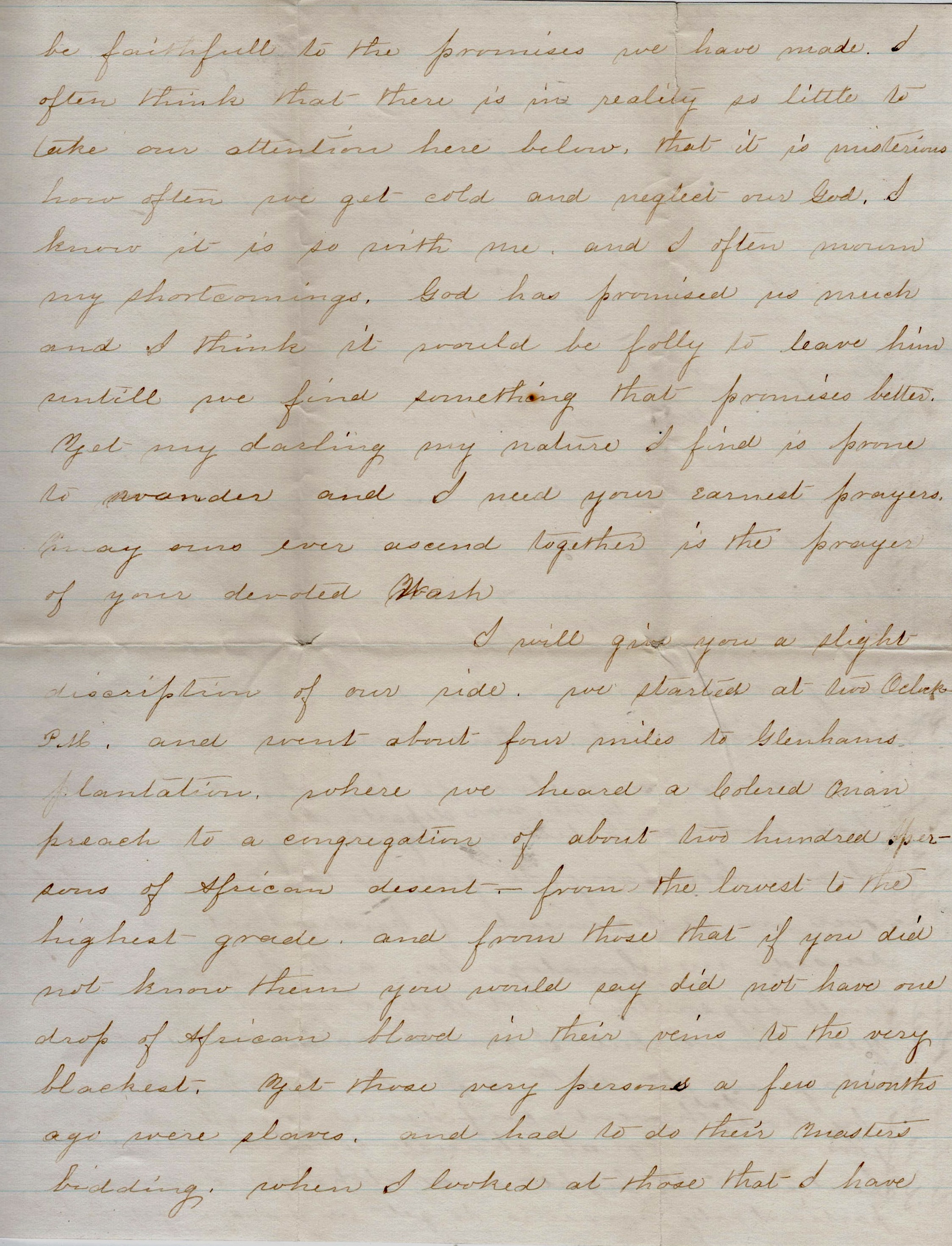
It is the quiet Sabbath eve. Now you will want to know what makes me so tired and I suppose I may as well tell you. Winne M. and myself (for want of anything more agreeable to do) got a couple of quartermaster horses and went out riding. When we started, we did not intend to go very far, but finally went as far as our outpost pickets—a distance of ten miles. Now when I tell you that I am not as accustomed to riding a real horse as I am the “Ideal” you will not wonder at my being weary and worn out. By the way, I remember a horse back ride I took a year ago last spring—through mud and snowbanks and for what—to enjoy the society of the one I love. Do you remember it, Ella? Those are times that are engraved in my mind never to be erased. And as I was riding along today I could not help but compare my position now with then. And how gladly would I have exchanged were it possible. But no, we must endure it yet awhile. It seems to me it can’t be much longer, and then we will know how to prize those little interviews. Although I did prize them at the time, but I did not know how much I was leaving when we parted—more than all the world besides to me. But it was only for a time and perhaps we will meet again, never to be parted until called away by death. And then, if prepared to meet the change that awaits us, we may meet again in a better, fairer land. How necessary then that we should be faithful to the promises we have made. I often think that there is in reality so little to take our attention here below—that it is mysterious how often we get cold and neglect our God. I know it is so with me, and I often mourn my shortcomings. God has promised us much and I think it would be folly to leave Him until we find something that promises better. Yet my darling my nature I find is prone to wander and I need your earnest prayers. May ours ever ascend together is the prayer of your devoted Wash.
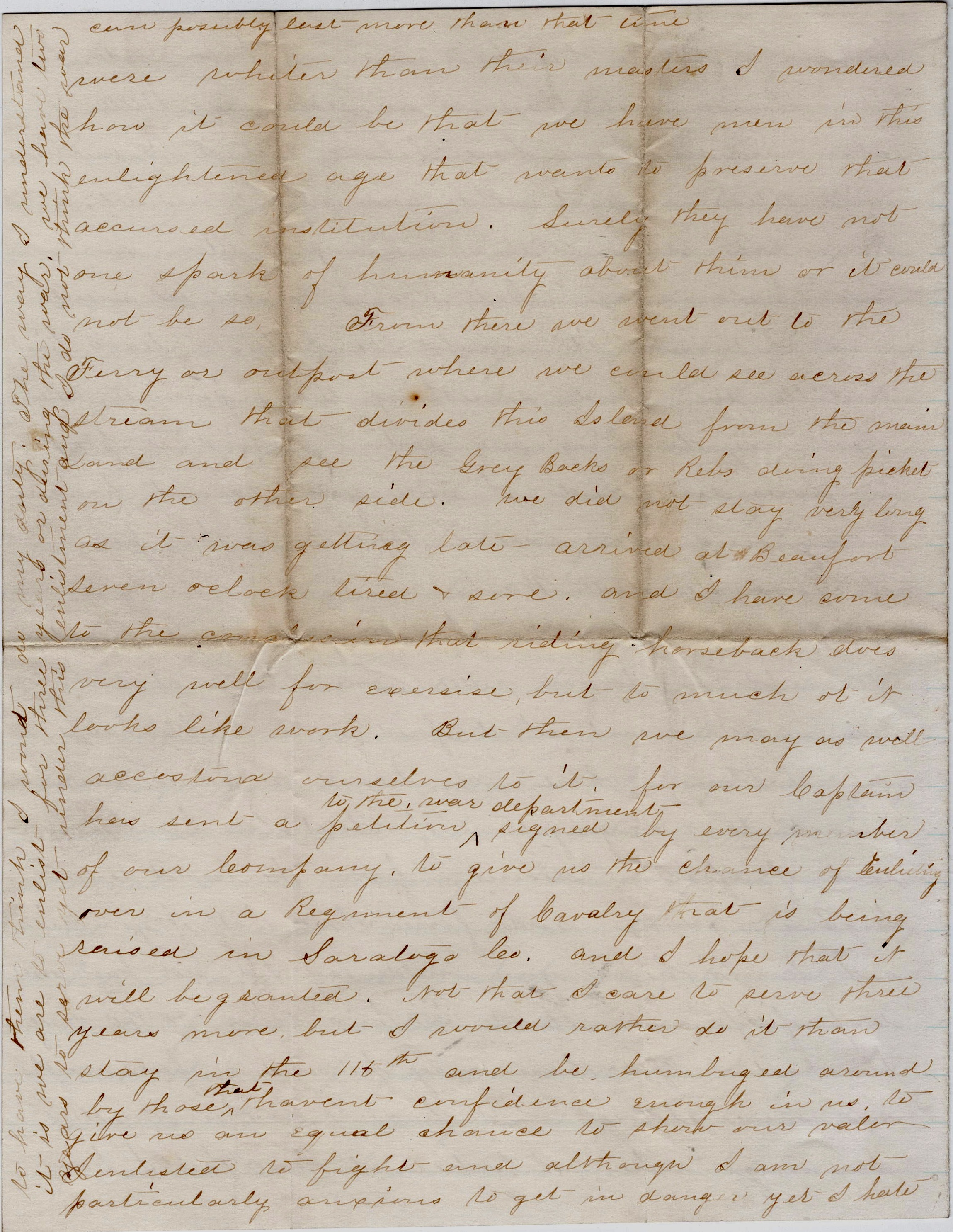
I will give you a slight description of our ride. We started at two o’clock p.m. and went about four miles to Glenhams Plantation where we heard a Colored man preach to a congregation of about two hundred persons of African descent, from the lowest to the highest grade, and from those that if you did not know them you would say did not have one drop of African blood in their veins to the very blackest. Yet those very persons a few months ago were slaves and had to do their masters bidding. When I looked at those that I have seen were whiter than their masters, I wondered how it could be that we have men in this enlightened age that want to preserve that accursed institution. Surely they have not one spark of humanity about them or it could not be so.
From there we went out to the Ferry or outpost where we could see across the stream that divides this island from the mainland and see the Grey Backs or Rebs doing picket on the other side. We did not stay very long as it was getting late. Arrived at Beaufort at seven o’clock tired & sore and I have come to the conclusion that rifing horseback does very well for exercise but too much of it looks like work. But then we may as well accustom ourselves to it for our Captain has sent a petition to the War Department signed by every member of our company to give us the chance of enlisting over in a regiment of cavalry that is being raised in Saratoga county and I hope that it will be granted. Not that I care to serve three years more but I would rather do it than stay in the 115th [New York] and be humbugged around by those that haven’t confidence enough in us to give us and equal chance to show our valor. I enlisted to fight and although I am not particularly anxious to get in danger, yet I hate to have them think I won’t do my duty. The way i understand it is we are to enlist for three years or during the wart. We have two years to serve yet under the enlistment and I do not think the war can possibly last more than that time.
I have just read over this scrawl and have a good mind not to send it—there is so many mistakes. If you can’t read it, just preserve it till I come & I will endeavor to assist you. Write soon and oblige your friend who often thinks of you. — Wash
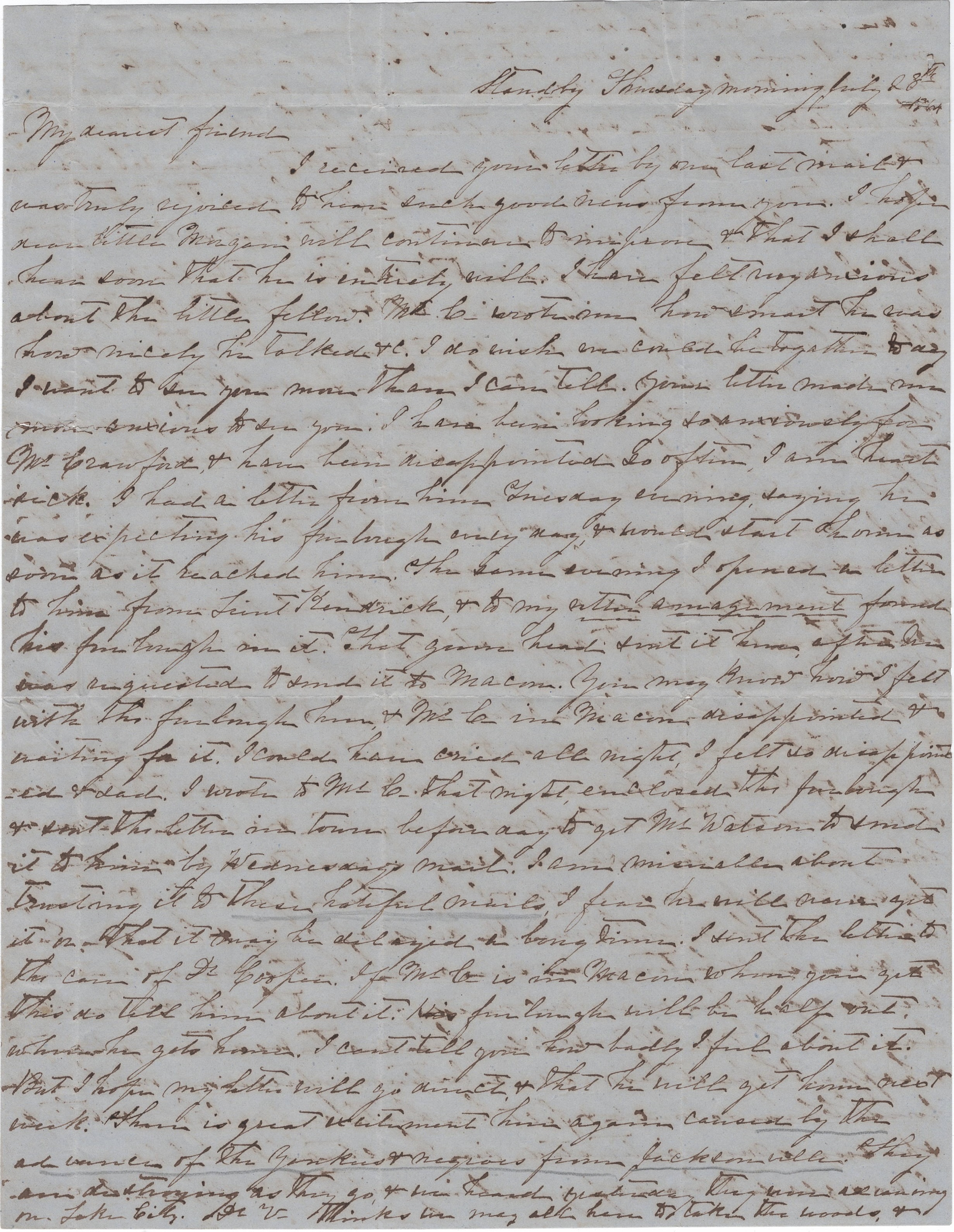
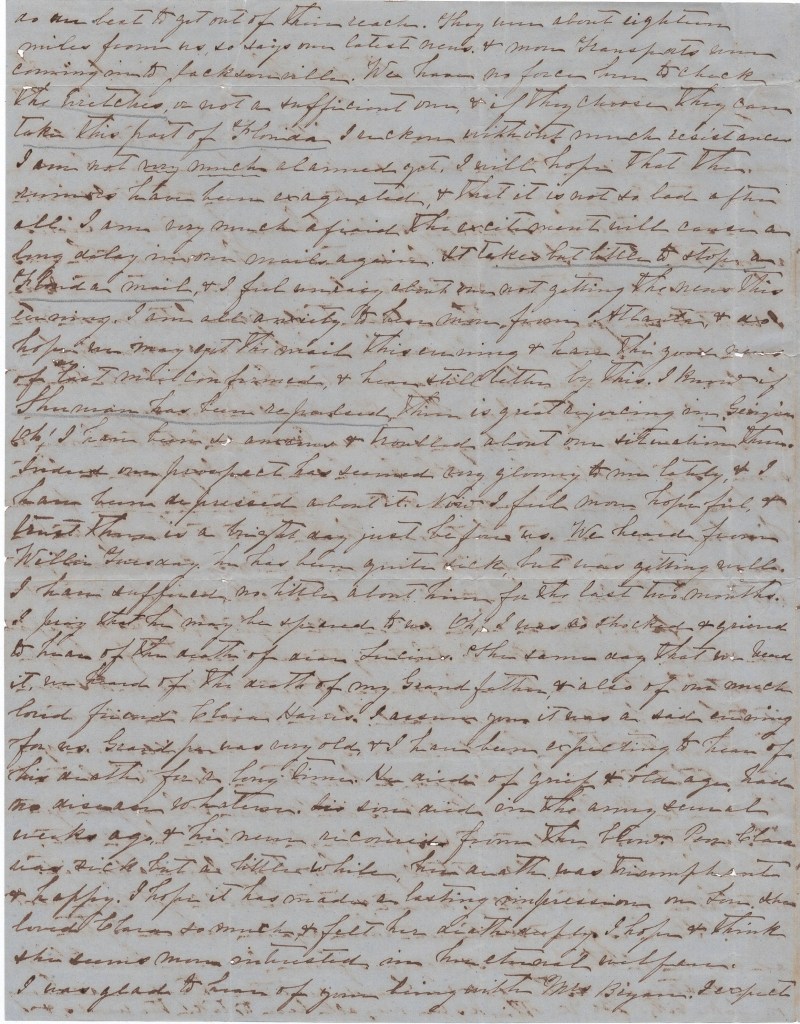
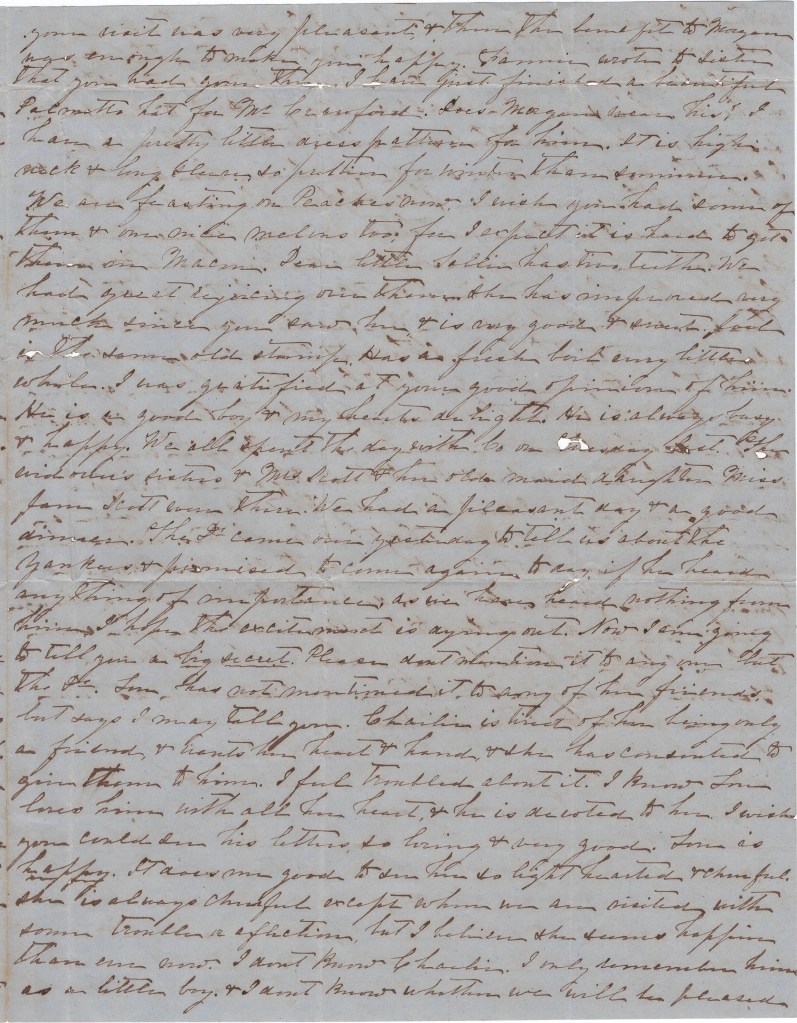
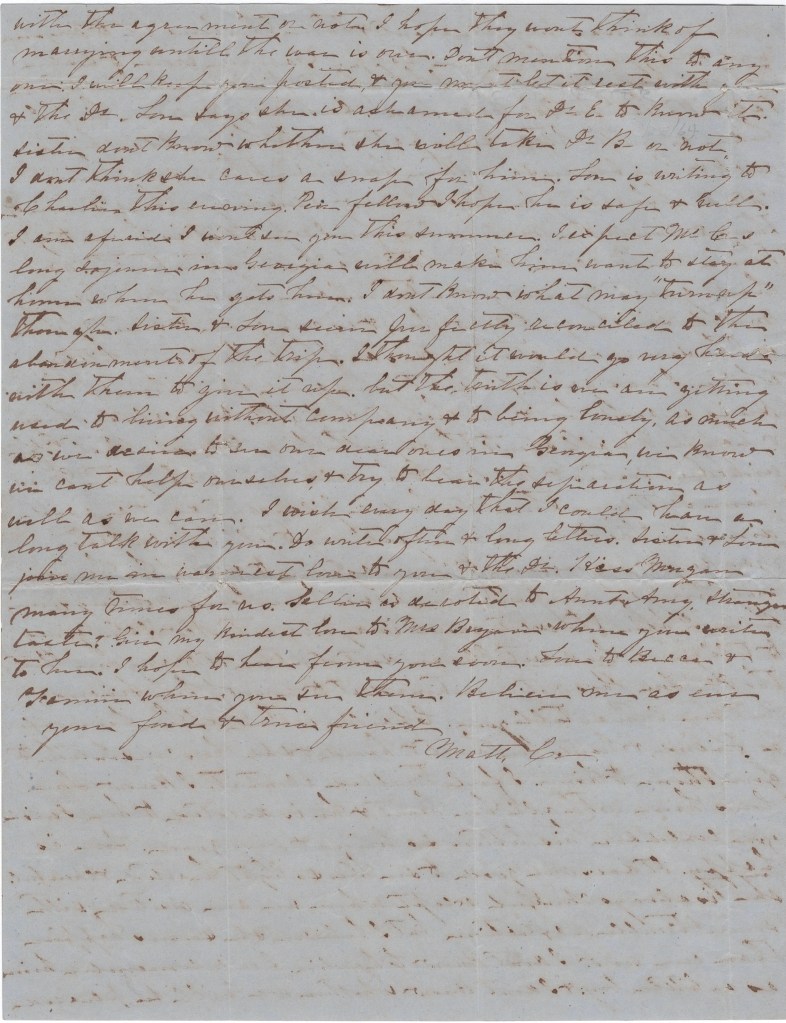
The following letter was written by Martha “Mattie” (Williamson) Crawford (1836-1876), the wife of Charles Peter Crawford (1831-1900), and the daughter of Capt. W. T. Williamson of Milledgeville, Georgia. Mattie’s husband Charles P. Crawford was a Yale graduate and Harvard trained lawyer; a Confederate officer; and the son of US Congressman Joel Crawford. The couple married in 1855. During the Civil War, Charles Crawford served as Captain of Co. C, Bonaud’s (28th) Battalion, Georgia Siege Artillery. This battalion was converted to infantry service in the spring of 1864 and redeployed to various locations, including Macon, Georgia. In January 1864, Charles was stationed near Quincy, Florida, performing provost guard duties for the town. “Company C, Bonaud’s battalion, Captain C. P. Crawford: Number of effective men, 65; armed with 65 Austrian rifles, with bayonets; accouterments complete, same as Company A; arms well cared for an in fair order. Station, near Quincy, Fla.” [letter by Capt. L. Jaquelin Smith, Assistant Chief of Ordnance] Charles resigned and left the service on 24 October 1864.
The letter is datelined on 28 July 1864 from “Standby” which I can only assume is the name of the plantation or estate from which Mattie wrote her letter.
According to census records, the Crawfords lived on a plantation near Starksville, Lee county, Georgia, in 1860. Further, according to family records, the family relocated from Georgia to Florida from 1863 to 1871. In 1870, the Crawford’s were enumerated in Gainesville, Alachua county, Florida. Their surviving wartime correspondence and estate papers are preserved in archival collections like the Crawford Family Letters in the Special Collections & Archives of Texas A&M University.
T R A N S C R I P T I O N
Standby Thursday morning July 28th 1864
My dearest friend,
I received your letter by our last mail and was truly rejoiced to hear such good news from you. I hope dear little Morgan will continue to improve & that I shall hear that he is entirely well. I have felt very anxious about the little fellow. Mr. C. wrote me how smart he was, how nicely he talked, &c. I do wish we could be together today. I want to see you more than I can tell. Your letter made me more anxious to see you. I have been looking so anxiously for Mr. Crawford & have been disappointed so often I am heartsick. I had a letter from him Tuesday evening saying he was expecting his furlough every day & would start home as soon as it reached him. The same evening I opened a letter to him from Lieut. Kendrick & to my utter amazement found his furlough in it that [ ] sent it him after he was requested to send it to Macon. You may know how I felt with the furlough here & Mr. C in Macon disappointed & waiting for it. I could have cried all night. I felt so disappointed & sad. I write to Mr. C. that night, enclosed the furlough & sent the letter in town before day to get Mr. Watson to send it to him by Wednesday’s mail. I am miserable about trusting it to these hateful mails. I fear he will never get it or that it may be delayed a long time. I sent the letter to the care of Dr. Cooper. If Mr. C. is in Macon when you get this, do tell him about it. His furlough will be half out when he gets home. I can’t tell you how badly I feel about it. But I hope my letter will go direct & that he will get home next week.
There is great excitement here again caused by the advance of the Yankees & negroes from Jacksonville. They are destroying as they go & we heard yesterday they were marching on Lake City [45 miles north of Gainesville]. Dr. V. thinks we may all have to take to the woods, & do our best to get out of their reach. They were about eighteen miles from us—so says our latest news—and more transports were coming into Jacksonville. We have no force here to check the wretches—or not a sufficient one—and if they choose, they can take this part of Florida I reckon without must resistance. I am not very much alarmed yet. I will hope that these rumors have been exaggerated & that it is not so bad after all. I am very much afraid the excitement will cause a long delay in our mails again. It takes but little to stop our Florida mail & I feel uneasy about our not getting the news this evening. I am all anxiety to hear more from Atlanta & do hope we may get the mail this evening & have the good news of our last mail confirmed & hear still better by this. I know if Sherman has been repulsed, there is great rejoicing in Georgia. Oh! I have been so anxious & troubled about our situation there. Indeed, our prospect has seemed very gloomy to me lately & I have been depressed about it. Now I feel more hopeful & trust there is a bright day just before us.
We heard from Wilber [on] Tuesday. He has been quite sick but was getting well. I have suffered no little about him for the last two months. I pray that he may be spared to us. Oh! I was so shocked & grieved to hear of the death of dear Lincin [?]. The same day that we heard it, we heard of the death of my grandfather & also of our much loved friend Clara Harris. I assure you, it was a sad evening for us. Grandpa was very old & I have been expecting to hear of his death for a long time. He died of grief & old age. Had no disease whatever. His son died in the army several weeks ago & he never recovered from the blow. Poor Clara was sick but a little while. Her death was triumphant & happy. I hope it has made a lasting impression on Lou. [ ] loved Clara so much & felt her death deeply. I hope & think she seems more interested in her eternal welfare. I was glad to hear of your being with Mrs. Bigam, I expect your visit was very pleasant & then the benefit to Morgan was enough to make you happy. Fannie wrote to sister that you had your [ ].
I have just finished a beautiful Palmetto hat for Mr. Crawford. Does Morgan wear his? I have a pretty little dress pattern for him. It is high neck & long sleeves so protection for winter, then summer. We are feasting on peaches now. I wish you had some of them & our nice melons too for I expect it is hard to get them in Macon. Dear little Sallie has two teeth. We had great rejoicing over them. She has improved very much since you saw him & is my good & sweet. [ ] is the same old stamp. Has a fresh boil [ ]. I was gratified at your good opinion of him. He is a good boy & my heart’s delight. He is always busy & happy. We all spent the day with company on Tuesday but the widowers sisters & Mrs. Scott & her old maid daughter, Miss Jane Scott was there. We had a pleasant day & a good dinner.
The Dr. came over yesterday to tell us about the Yankees & promised to come again today if he heard anything of importance as we have heard nothing from him. I hope the excitement is dying out. Now I am going to tell you a big secret. Please don’t mention it to anyone but the Dr. Tom has not mentioned it to any of his friends but says I may tell you. Charlie is tired of her being only a friend & wants her heart & hands & she has consented to give them to him. I feel troubled about it. I know Lou loves him with all her heart & he is devoted to her. I wish you could have seen his letters—so loving & very good. Lou is happy. It does me good to see him so light-hearted & cheerful. She is always cheerful except when we are visiting with some trouble or affliction but I believe she seems happier than ever now. I don’t know Charlie. I only remember his as a little boy & don’t know whether we will be pleased with the agreement or not. I hope they won’t think of marrying until the war is over. Don’t mention this to anyone. I will keep you posted & you must let it rest with you & the Dr. Lou says she asked as much for Dr. E. to know it. Sister don’t know whether she will rake Dr. B or not. I don’t think she cares a snap for him. Lou is writing to Charlie this morning. Poor fellow, I hope he is safe & well. I am afraid I won’t see you this summer. I expect Mr. C’s long sojourn in Georgia will make him want to stay at home when he gets home. I don’t know what may “turn up” though.
Sister & Lou seem perfectly reconciled to their abandonment of the trip. I thought it would go very hard with them to give it up but the truth is we are getting used to living without company & to being lonely. As much as we desire to see our dear ones in Georgia, we know we can’t help ourselves & try to bear the separation as well as we can. I wish every day that I could have a long talk with you. Do write often & long letters. Sister & Lou join me in warmest love to you & the Dr. Kiss Morgan many times for us….Give my kindest love to Mrs. Bryan when you’re writing to her. I hope yp hear from you soon. Love to Becca & Fannie when you see them. Believe me as ever your fond & true friend, — Matt. C.
The following letters were written by British emigrant Joseph W. Luxford (or Laxford) (1838-1862) of North Troy, Orleans county, Vermont. Joseph enlisted as a private in Co. D, 6th Vermont Infantry on 29 August 1861 and was mustered in on 15 October 1861. Within two weeks of his muster, as can be seen in Letter 1, he was transported with his regiment to Camp Griffin in Virginia where they spent the winter of 1861-62. Before spring, however, Joseph had died. Muster rolls record his death as having taken place at the Broad & Cherry General Hospital in Philadelphia on 23 February 1862. The cause of death was Diphtheria.
Descriptions of Joseph’s illness and death were captured in two letters written by Moses Abbott who served in the same company with him. These letters are housed at the University of Virginia and have been transcribed on-line. See:
(6624) [writer] ~ Moses Abbott to Dinah Luxford, 1 February 1862
(6625) [writer] ~ Moses Abbott to Dinah Luxford, 26 February 1862
Joseph was the son of Henry Luxford and Mary Tabitha Turner of Kent, England. It appears the family must have emigrated to the US in the 1840s. Joseph wrote the letter to his sister Dinah.
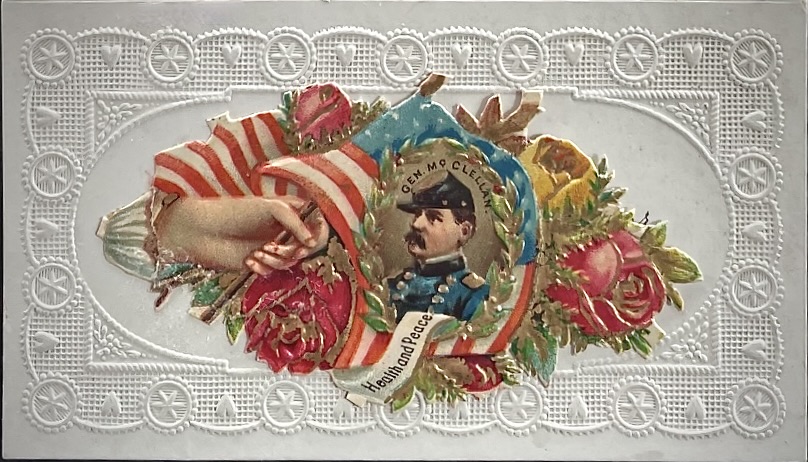
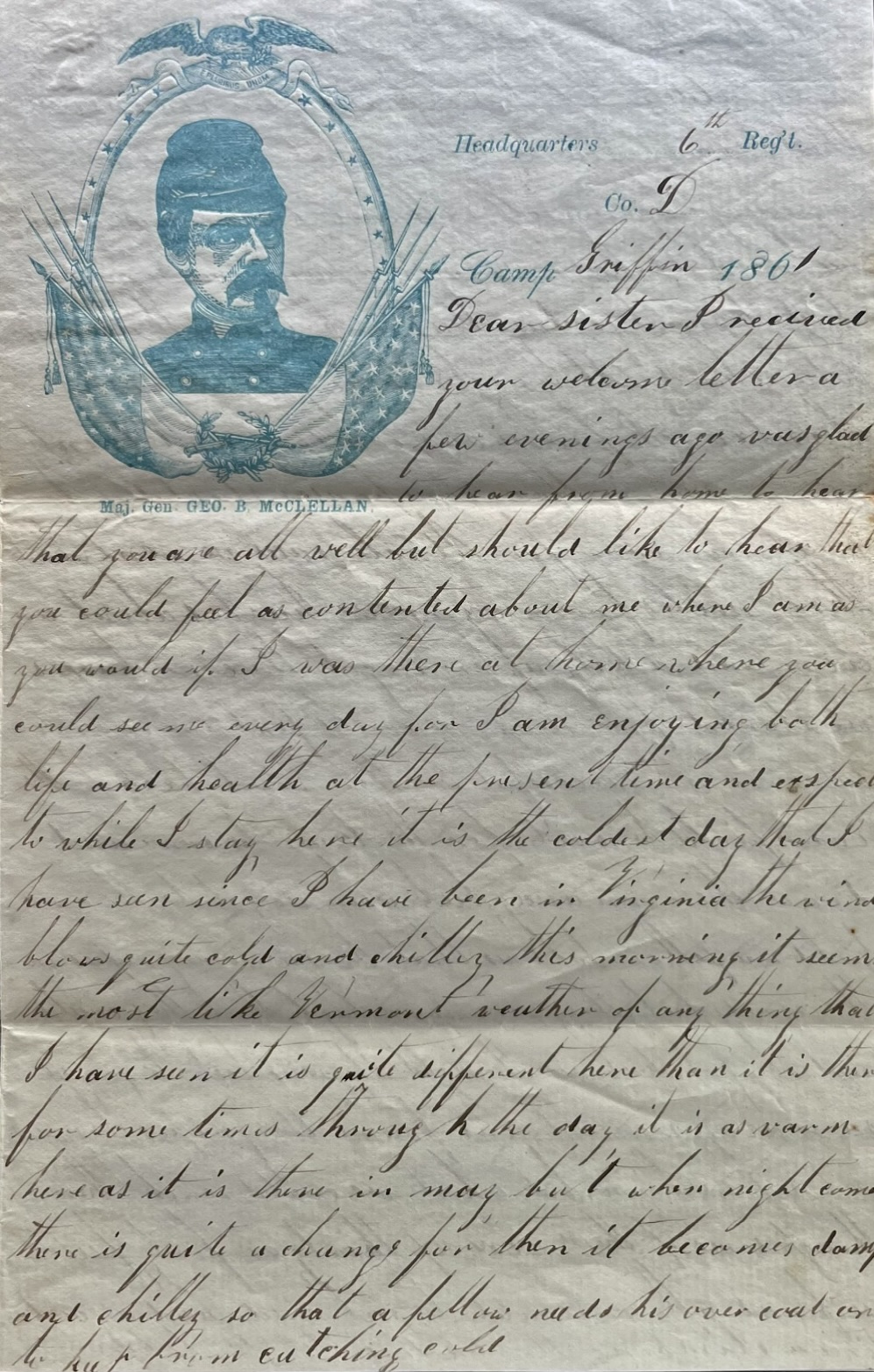
Enclosed with Letter 2 was this calling card with the words, “Health and Peace” and the visage of Gen. McClellan.
[Note: These letters are from the private collection of Greg Herr and were made available for transcription and publication on Spared & Shared by express consent.]
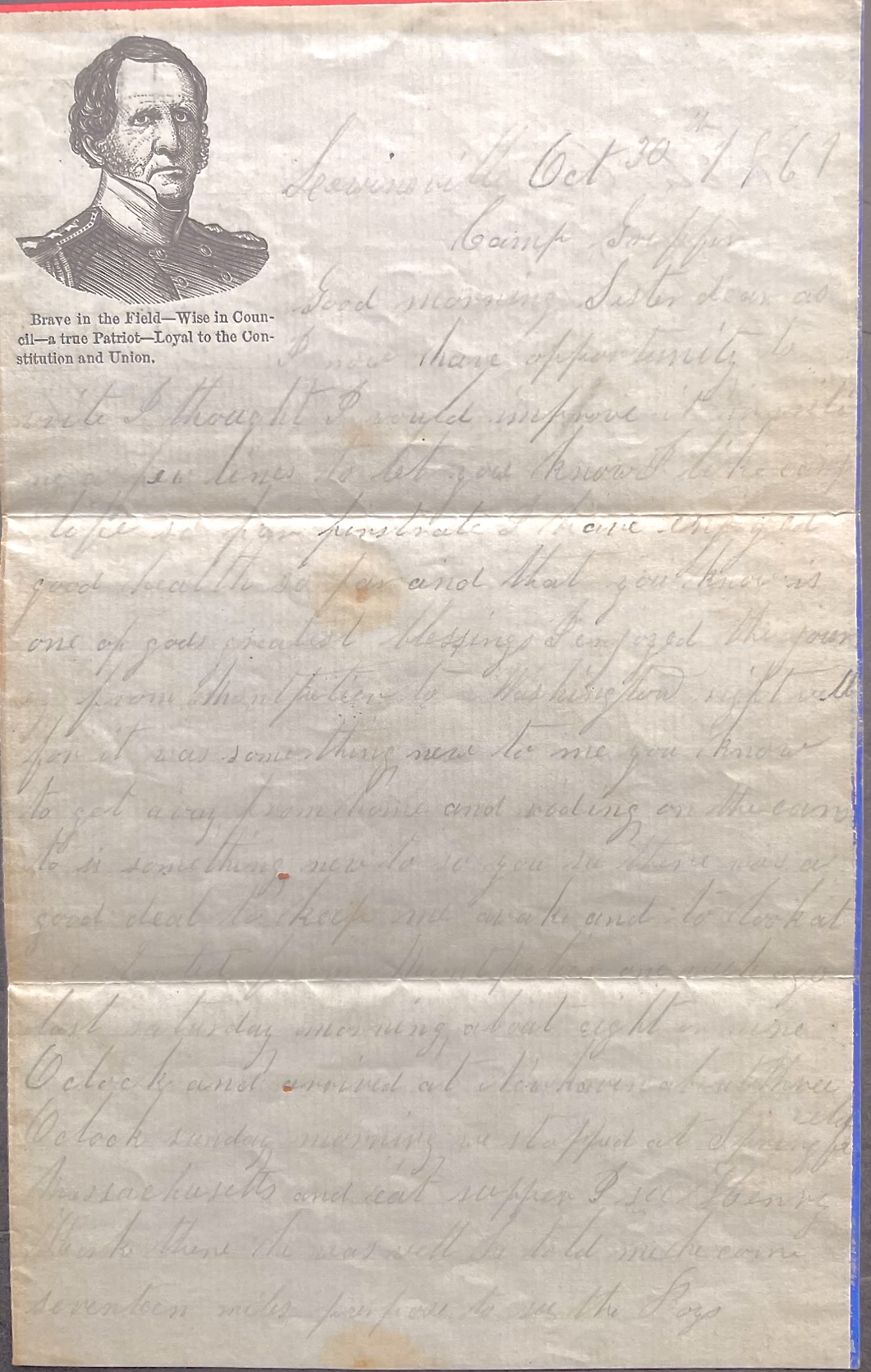
Letter 1
Lewinsville Camp Griffin October 30th 1861
Good morning sister,
As I have opportunity to write, I thought I would improve it and write you a few lines to let you know I like camp life so far first rate. I have enjoyed good health so far and that you know is one of God’s greatest blessings. I enjoyed the journey from Montpelier to Washington right well for it was something new to me, you know—to get away from home and riding on the cars—to see something new too. So you see there was a good eal to keep me awake and to look at.
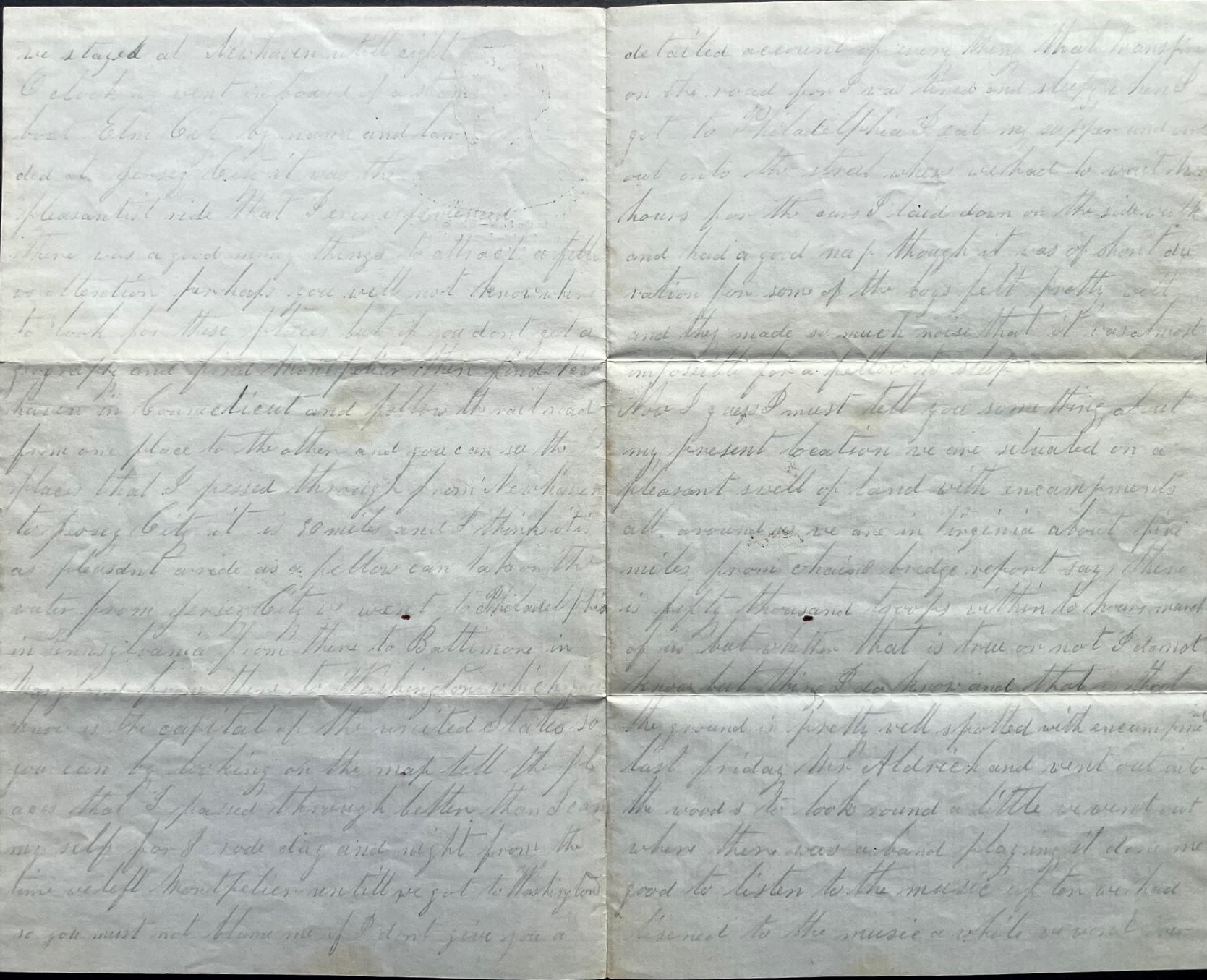
We started from Montpelier one week ago last Saturday morning about eight or nine o’clock. Sunday morning we stopped at Springfield, Massachusetts and eat supper. I see Henry Kirk there. He was well. He told me he come seventeen miles [for the] purpose to see the boys. We stayed at New Haven until eight o’clock, went on board a steamboat—Elm City by name—and unloaded at Jersey City. It was the pleasantest ride that I ever experienced. There was a good many things to attract our attention. Perhaps you will not know what to look for [in] these places but if you don’t, go to Geography and find Montpelier. Then find New Haven in Connecticut and follow the railroad from one place to the other and you can see the places that I passed through. From New Haven to Jersey City it is 90 miles and I think it’s as pleasant a ride as a fellow can take on the water.
From Jersey City we went to Philadelphia in Pennsylvania. From there to Baltimore in Maryland. From there to Washington which you know is the Capitol of the United States. You can, by looking on the map, tell the places that I passed through better than I myself for I rode day and night from the time we left Montpelier until we got to Washington so you must not blame me if I don’t give you a detailed account of everything that transpired on the road for I was tired and slept. When we got to Philadelphia, I eat my supper and went out into the street where we had to wait two hours for the cars. I laid down on the sidewalk and had a good nap though it was of short duration for some of the boys felt pretty well and they made so much noise that it was almost impossible for a fellow to sleep.
Now I guess I must tell you something about my present location. We are situated on a pleasant swell of land with encampments all around us. We are in Virginia about five miles from Chain Bridge. Report says there is 50,000 troops within two hours march of us but whether that is true or not, I do not know. But one thing I do know and that is that the ground is pretty well spotted with encampments.
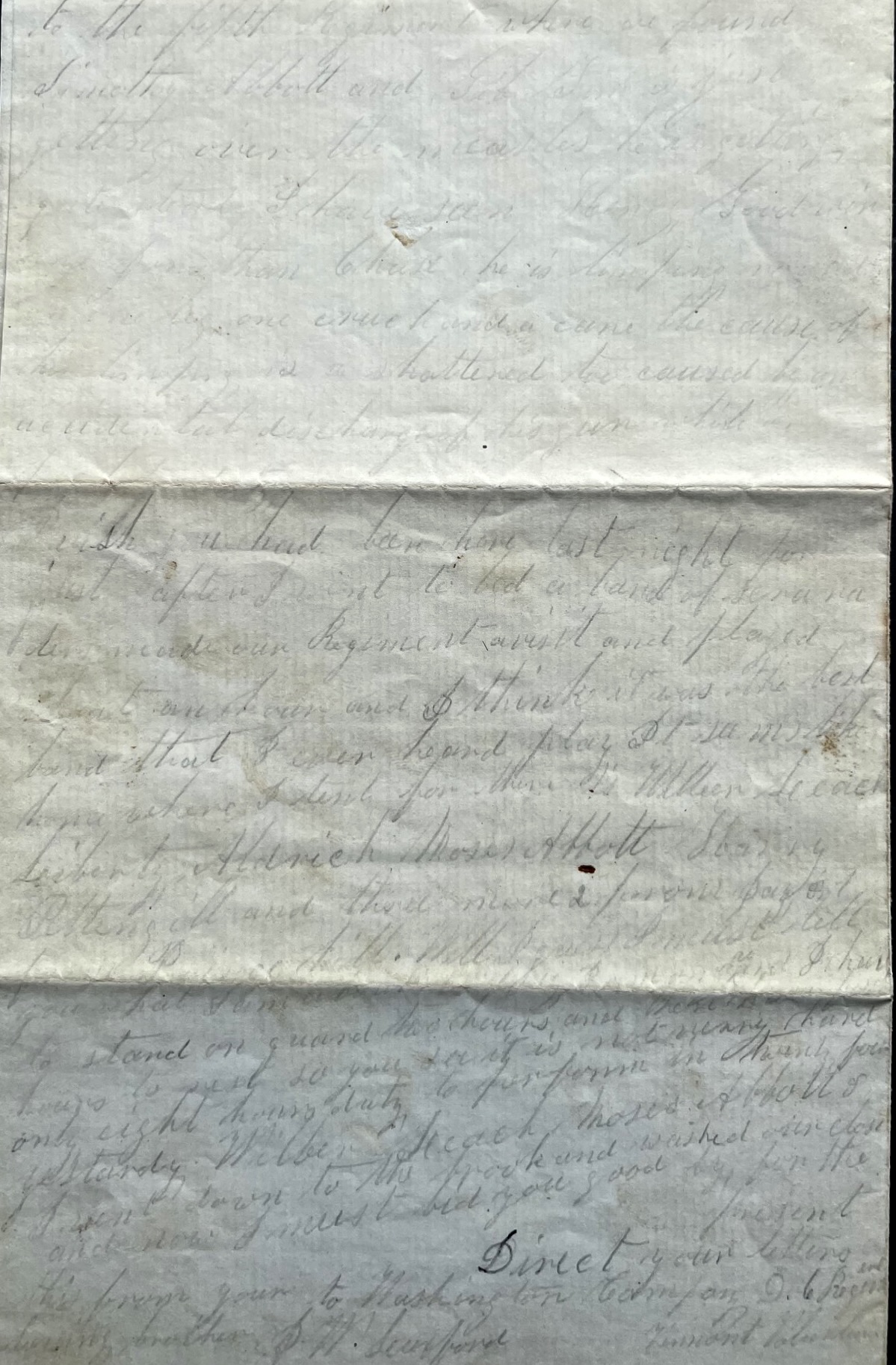
Last Friday, Mr. [Liberty] Aldrich and [I] went out in the woods to look around a little. We went out where there was a band playing. It done me good to listen to the music. After we had listened to the music awhile, we went over to the 5th [Vermont] Regiment where we found Timothy Abbott and he was just getting over the measles. He is getting quite strong. I have seen Goodwin…one by one crutch and a cane, the cause of …fingers is shattered too caused by an accidental discharge of his gun while on…
I wish you had been here last night for just after I went to bed, a band of serenaders made our regiment a visit and played about an hour and I think it was the best band that I ever heard play. It seems like home where I tent for there is Wilbur Leach, Liberty Aldrich, Moses Abbott, Harry Pettingill and three more. Two persons from P____Hill.
Well. I guess I must tell you what I am now [illegible]…to stand on guard two hours and then…
Wilber Leach, Moses Abbott and I went down to the brook and washed our clothes and now I must tell you goodbye for the present. This from your loving brother, — J. W. Luxford
Direct your letters to Washington, Company D, 6th Regiment Vermont Volunteers.
Letter 2
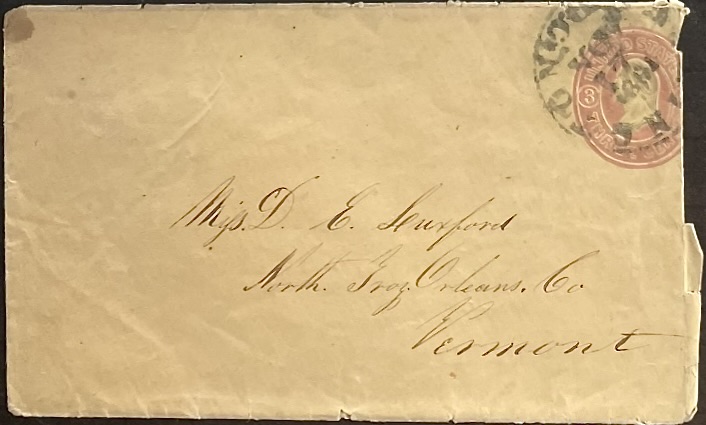
Directed to Miss D. E. Luxford, North Troy, Orleans county, Vermont
I received your welcome letter a few evenings ago. Was glad to hear that you are all well but should like to hear that you could feel as contented about me where I am as you would if I was there at home where you could see me every day for I am enjoying both life and health at the present time and expect to while I stay here.
It is the coldest day that I have seen since I have been in Virginia. The wind blows quite cold and chilly this morning. It seems the most like Vermont weather of anything that I have seen. It is quite different here than it is there for some times through the day, it is as warm here as it is there in May. But when night comes, there is quite a change for then it becomes damp and chilly so that a fellow needs his overcoat on to keep from catching cold.
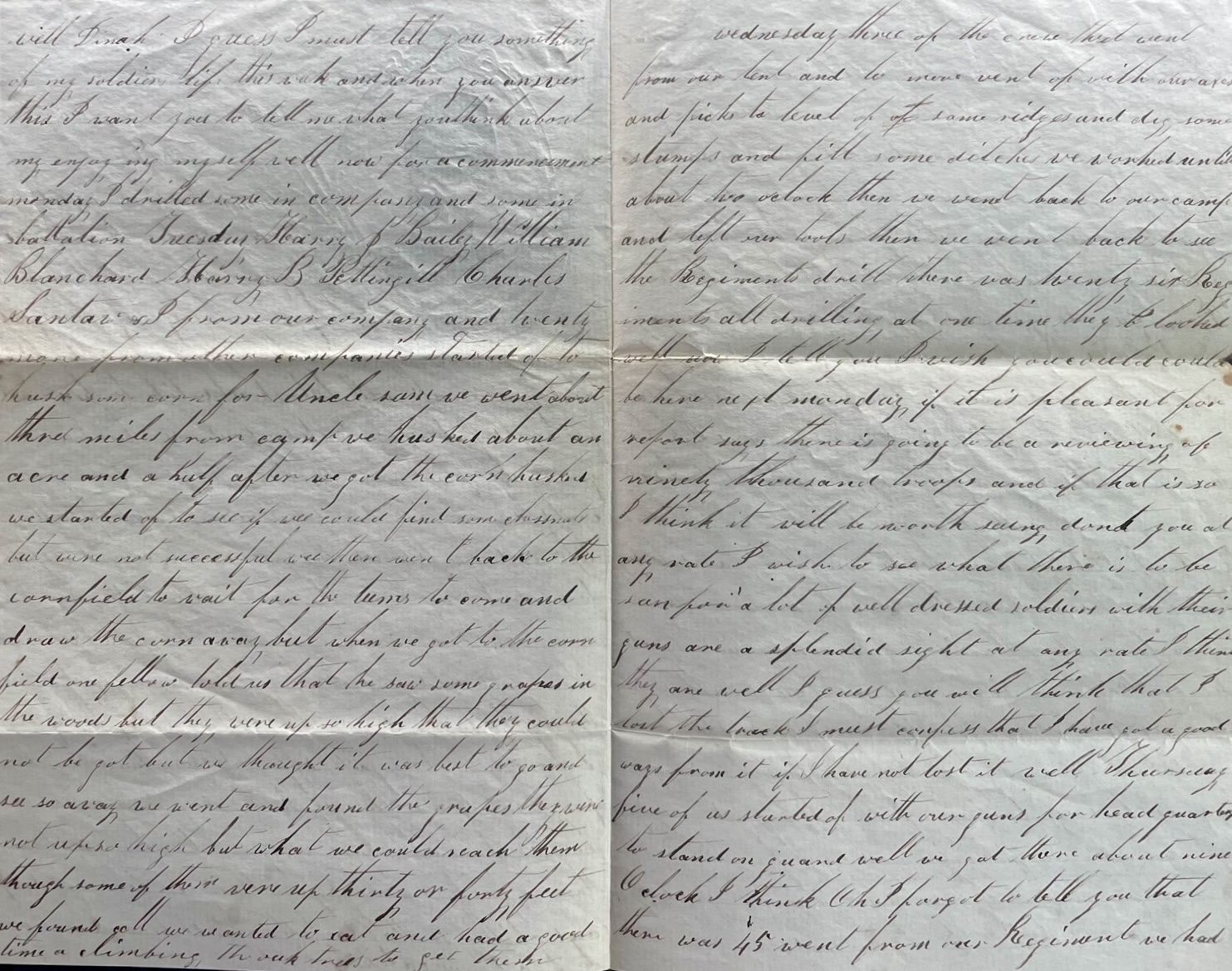
Well, Dinah, I guess I must tell you something of my soldier’s life this week and when you answer this, I want you to tell me what you think about my enjoying myself. Well now, for a commencement, Monday I drilled some in company and some in battalion.
Tuesday, Harry J. Bailey, William Blanchard, Harry B. Pettingill, Charles Santau and I from our company and twenty more from other companies started off to husk some corn for Uncle Sam. we went about three miles from camp, We husked about an acre and a half. After we got the corn husked, we started off to see if we could find some classmates but were not successful. We then went back to the cornfield to wait for the teams to come and draw the corn away but when we got to the cornfield, one fellow told us that he saw some grapes in the woods but they were up so high that they could not be got. But we thought it was best to go and see so away we went and found the grapes. They was not up so high but what we could reach them though some of them were up thirty or forty feet. We found all we wanted to eat and had a good time a climbing through trees to get them.
Wednesday, three of the crew that went to our tent and two more went up with our axes and picks to level off some ridges and dig some stumps and fil some ditches. We worked until about two o’clock. Then we went back to our camp and left our tools. Then we went back to see the regiments drill. There was 26 regiments all drilling at one time. They looked well now, I tell you. I wish you could be here next Monday if it is pleasant for report says there is going to be a reviewing of 90,000 troops and if that is so, I think it will be worth seeing, don’t you? At any rate, I wish to see what there is to be seen for a lot of well-dressed soldiers with their guns are a splendid sight. At any rate, I think they are. Well, I guess you will think that I lost the track. I must confess that I have got a good ways from it if I have not lost it.
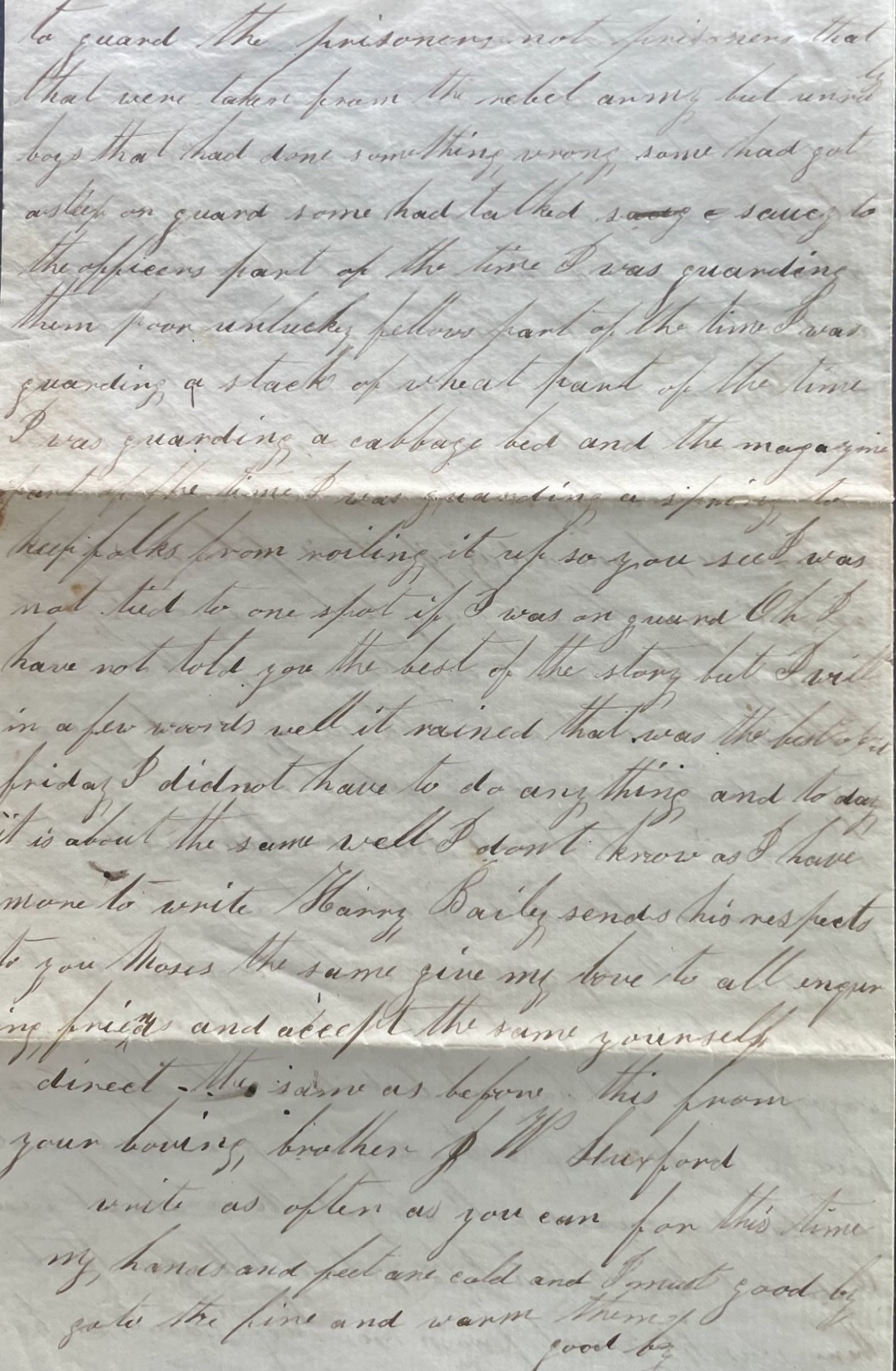
Well Thursday five of us started off with our guns for headquarters to stand on guard. Well, we got there about nine o’clock, I think. Oh, I forgot to tell you that there was 45 went from our regiment. We had to guard the prisoners—not prisoners that were taken from the rebel army but unruly boys that had done something wrong. Some had got asleep on guard, some had talked saucy to the officers. Part of the time I was guarding them poor unlucky fellows, part of the time I was guarding a stack of wheat, part of the time I was guarding a cabbage bed and the magazine, part of the time I was guarding spring to keep folks from roiling it up. So you see I was not tied to one spot [even] if I was on guard. Oh, I have not told you the best of the story but I will in a few words. Well, it rained—that was the best of it.
Friday I didn’t have to do anything and today it is about the same. Well, I don’t know as I have more to write. Harry Bailey sends his respects to you. Moses [Abbott] the same. Give my love to all enquiring friends and accept the same yourself. Direct the same as before. This from your loving brother, — J. W. Luxford
Write as soon as you can for this time my hand and feet are cold and I must [say] goodbye and go to the fire and warm them up, Goodbye.
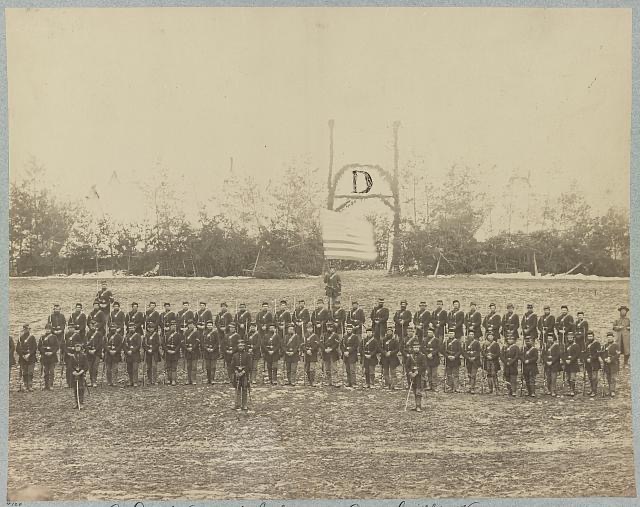
Co. D, 6th Vermont Infantry at Camp Griffin, Virginia. (LOC)
A watercolor of Charles Anderson Raine in later years.
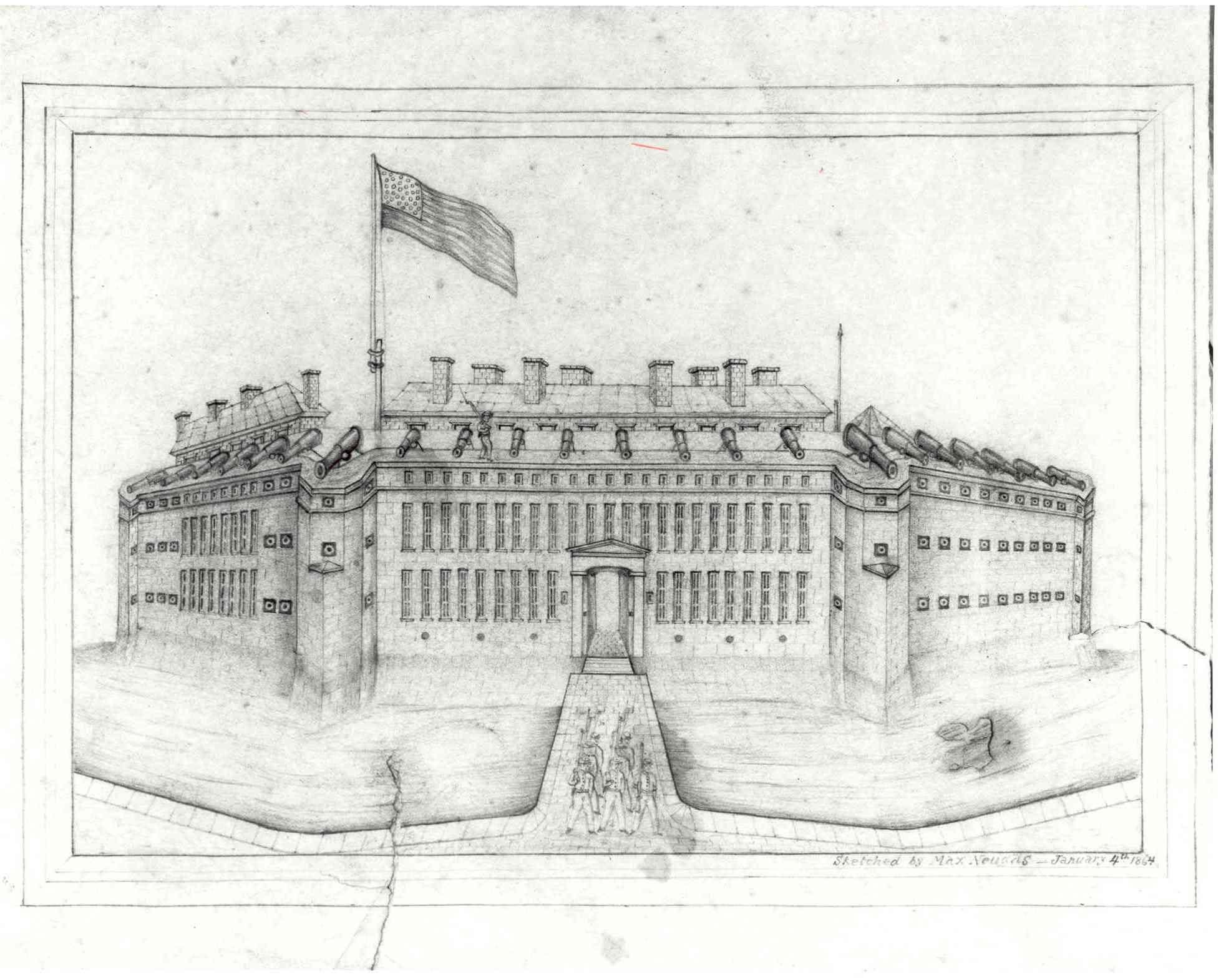
Charles Anderson Raine (1841–1902) was a Confederate soldier from Virginia who was captured during the American Civil War and held as a prisoner of war at Fort Delaware on Pea Patch Island. The diary he kept while a prisoner is housed at Washington & Lee University Special Collections and Archives (Identifier WLU-Coll-0574). The description of that diary reads as follows:
“According to Raine’s opening inscription, this leather bound pocket diary was a gift to Charles A. Raine from fellow Fort Delaware prisoner Lt. Henry C. Cromwell of the 10th Kentucky Cavalry on August 4, 1864. Raine had just arrived at Fort Delaware as a Confederate prison of war. The diary is written in both pencil and ink. The first twenty pages are Raine’s notes on various subjects of English history. After a gap of blank pages, Raine’s diary entries begin on January 1, 1865 and continue until his release on June 17, 1865. The final paragraph of the diary section details his journey home to Virginia. Entries vary in length, averaging a few lines per day, and detail the weather, Raine’s physical and emotional state and the miseries of prison life, news of fellow prisoners, preaching and religious exercises in the barracks, letters written and received, parcels and money received, news concerning the war and prisoner exchanges, and thoughts on his imprisonment and the future. Notable entries include the news of General Robert E. Lee’s surrender and his entries mentioning debate topics and results by a debating club formed among prisoners. The next section of the book includes a letter draft to a friend, a number of pages of poetry, miscellaneous literary excerpts including a page of notable lines of Shakespeare, and some accounting records that may be post-war. The final section of the book includes autographs, addresses, and some personal notes from sixty-three fellow prisoners. The diary also had within it a number of loose items including letters received, poems, notes, etc… written by him and other authors during his imprisonment and in the post-war years.”
When Raines was 55 years old (in 1897), he wrote a brief autobiography at his children’s request. In it he described his war years as a member of Co. E, 23rd Virginia Infantry—part of Stonewall Jackson’s foot soldiers. In describing his capture in May 1864, Raines wrote that he with other prisoners were marched to Fredericksburg, then to Acquia Creek, then to Point Lookout, Maryland, for 6 weeks, “undergoing all sorts of indignities…by the Negro troops (ex-slaves) who guarded us.” Finally they were moved to Fort Delaware, reaching there in late June 1864.
Of his experience at Fort Delaware he wrote: “Recollections of prison life at Ft. Delaware can never be blotted from my memory. To the kindness of Southern sympathizers in Baltimore and elsewhere within the Federal lines are many of us indebted for the only comforts we had. We were both clothed and fed by these good people. The scanty and unwholesome allowances of rations – wormeaten beans, tough beef and half risen hard bread – were barely sufficient to sustain life. I feel and hope that all of my children will ever feel a debt of deepest gratitude to Mrs. Ann [should be Jane] Eliza Bestor and Miss Alice Kay Howard of Baltimore for their kindness to me in furnishing clothing, books and writing material, without which I could not have lived.”
Raines remained in Fort Delaware until after Lee’s surrender of the Army of Northern Virginia when he took the oath of allegiance and was released. [See C. A. Raine’s Autobiography]
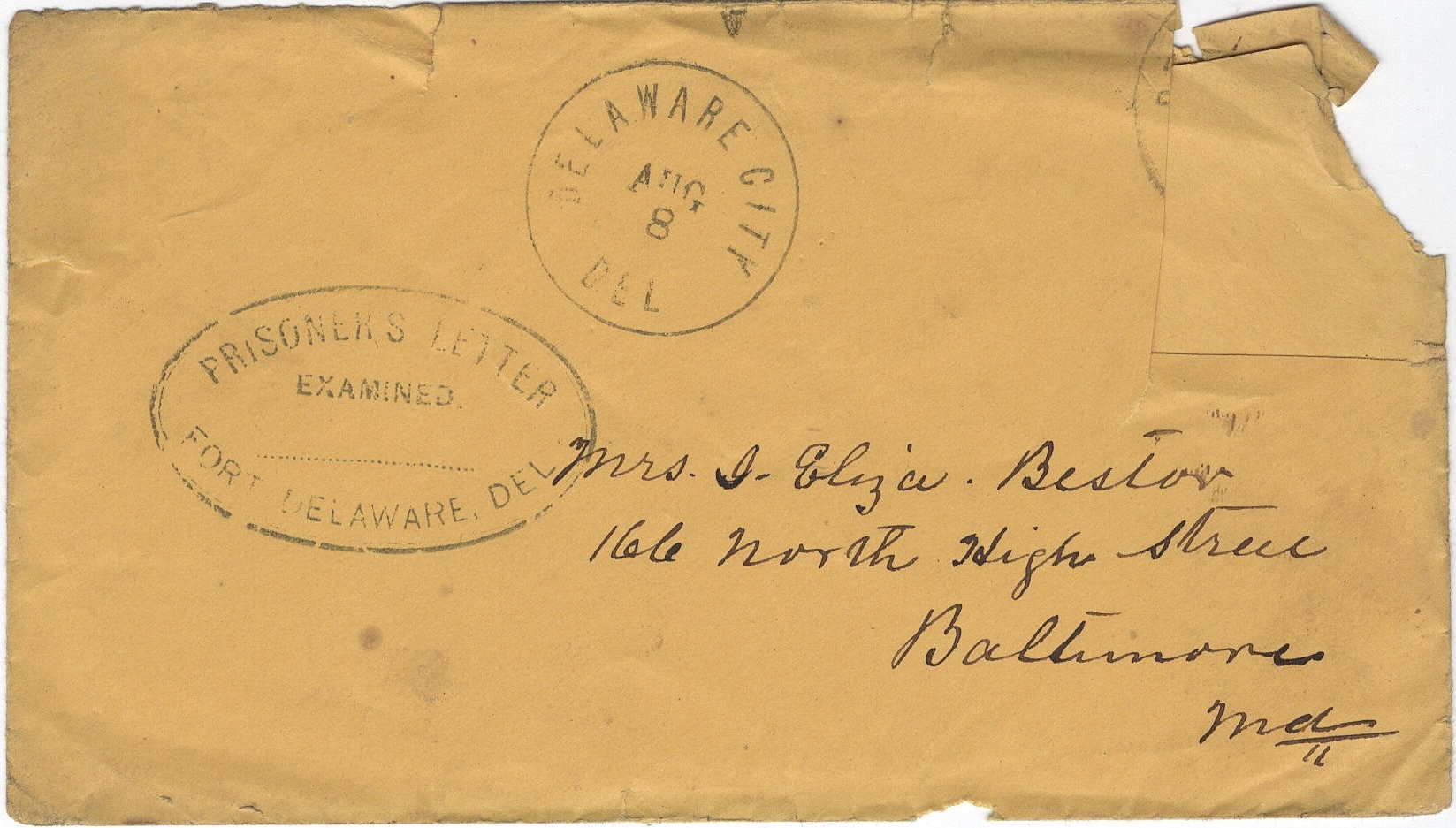
Raine wrote the letters to Jane Eliza (Brown) Bestor (1820-1885), the wife of John Rollin Bestor, Sr. (1813-1867). This Baltimore couple had twin sons who served in the Maryland Guard that became Co. B, 21st Virginia Infantry. Eliza seems to have corresponded with numerous Confederate soldiers seeking information about her sons. The Bestor brothers’ letters have been transcribed and may be found at 1861-65: The Bestor Brothers of Baltimore.
Letter 1
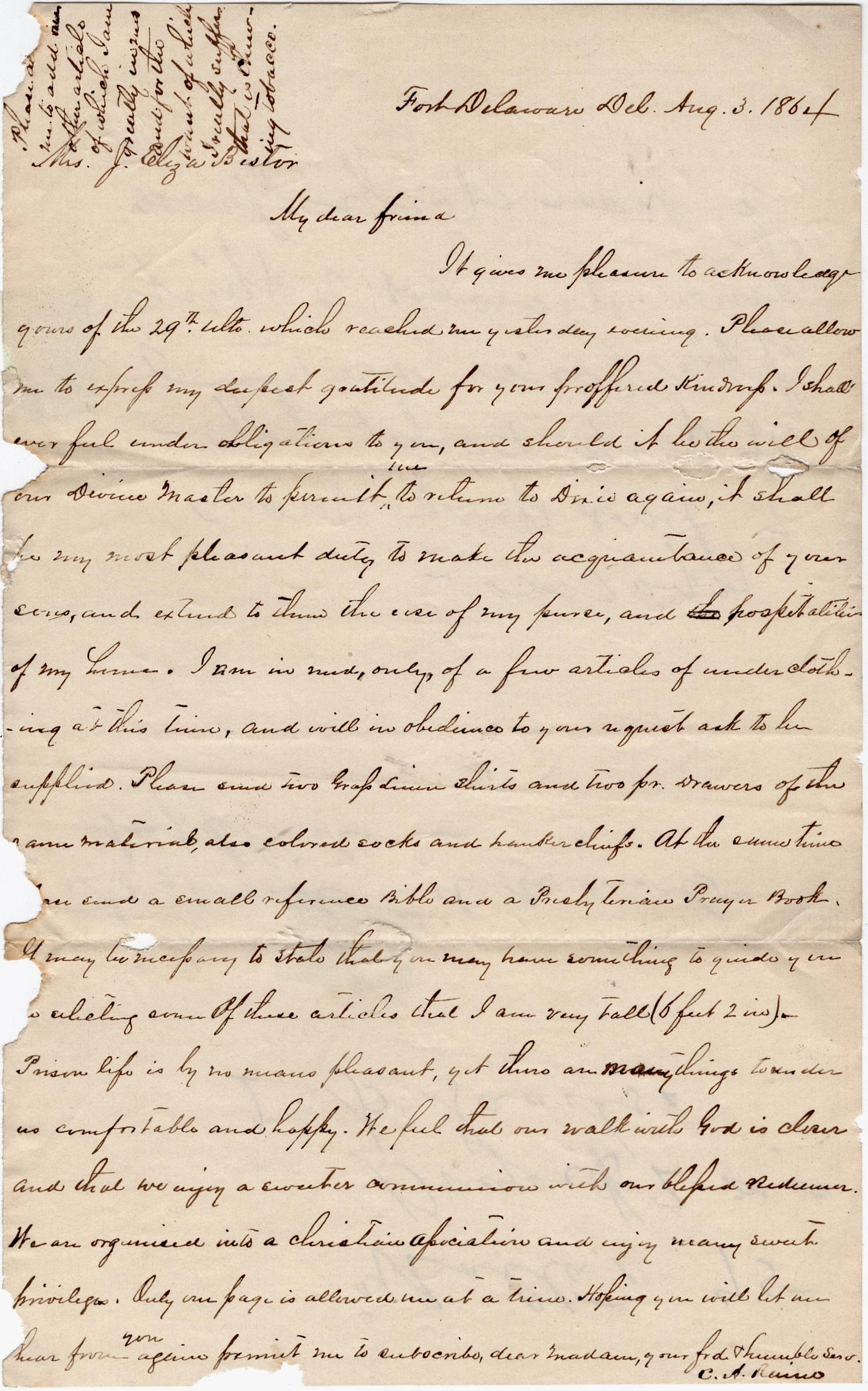
Fort Delaware, Del. Aug. 3, 1864
Mrs. J. Eliza Bestor
My dear friend, it gives me pleasure to acknowledge yours of the 29th ulto. which reached me yesterday evening. Please allow me to express my deepest gratitude for your proffered kindness. I shall ever feel under obligations to you, and should it be the will of our Divine Master to permit me to return to Dixie again, it shall be my most pleasant duty to make the acquaintance of your sons, and extend to them the use of my purse, and hospitalities of my home.
I am in need only of a few articles of underclothing at this time, and will in obedience to your request ask to be supplied. Please send two grass linen shirts and two pair drawers of the same material. Also colored socks and handkerchiefs. At the same time, please send a small reference Bible and a Presbyterian Prayer Book. It may be necessary to state that you may have something to guide you in selecting some of these articles that I am very tall (6 feet 2 inches).
Prison life is by no means pleasant, yet there are many things to render us comfortable and happy. We feel that our walk with God is closer and that we enjoy a sweeter communion with our blessed Redeemer. We are organized into a Christian Association and enjoy many sweet privileges. Only one page is allowed me at a time. Hoping you will let me hear from you again, permit me to subscribe, dear Madam, your friend & humble servant, — C. A. Raine
Please allow me to add another article of which I am greatly in need and for the want of which I really suffer—that is chewing tobacco.
Letter 2
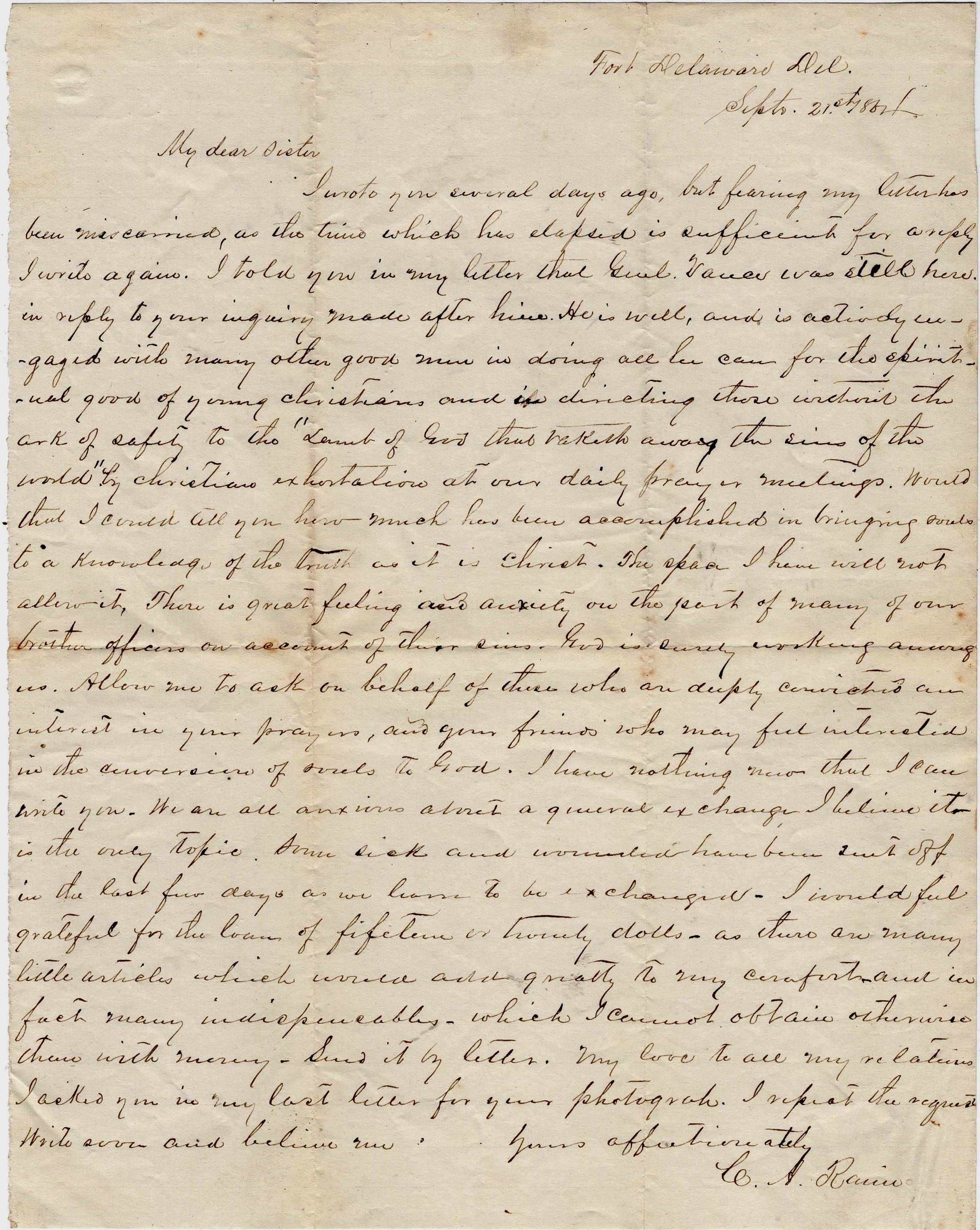
Fort Delaware, Del. Sept. 21st 1864
My dear sister,
I wrote you several days ago, but fearing my letter has been miscarried, as the time which has elapsed is sufficient for a reply, I write again. I told you in my letter that Gen. Vance was still here in reply to your inquiry made after him. He is well, and is actively engaged with many other good men in doing all he can for the spiritual good of young Christians and in directing those without the ark of safety to the “Lamb of God that taketh away the sins of the world” by christian exhortation at our daily prayer meetings. Would that I could tell you how much has been accomplished in bringing souls to a knowledge of the truth as it is Christ [but] the space I have will not allow it. There is great feeling and anxiety on the part of many of our brother officers on account of their sins. God is surely working among us. Allow me to ask on behalf of those who are deeply convicted an interest in your prayers, and your friends who may feel interested in the conversion of souls to God.
I have nothing new that I can write you. We are all anxious about a general exchange. I believe it is the only topic. Some sick and wounded have been sent off in the last few days, as we learn, to be exchanged. I would feel grateful for the loan of fifteen or twenty dollars as there are many little articles which would add greatly to my comforts and in fact many indispensables which I cannot obtain otherwise than with money. Send it by letter. My love to all of my relations. I asked you in my last letter for your photograph. I repeat the request. Write soon and believe me. Yours affectionately, — C. A. Raine
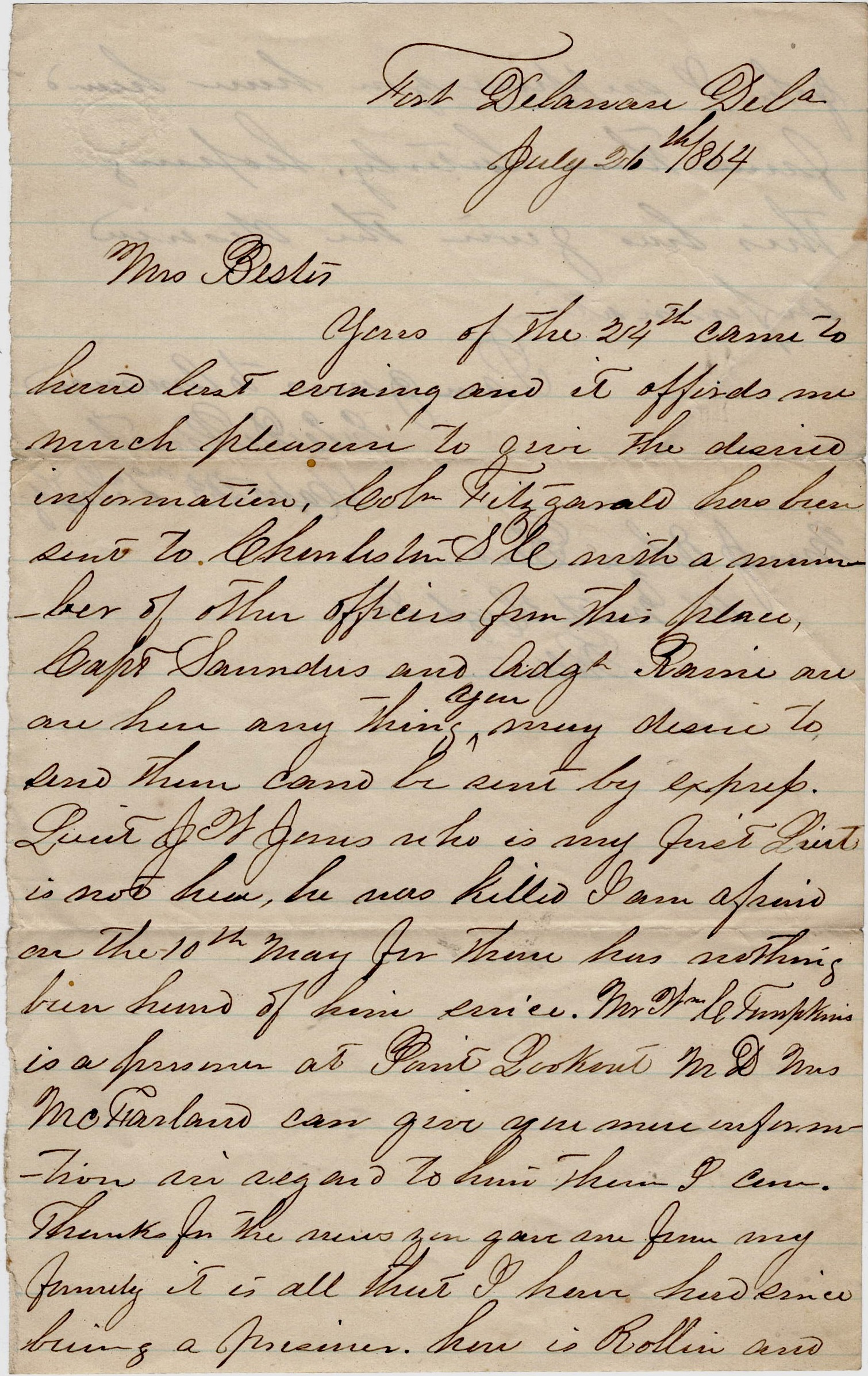
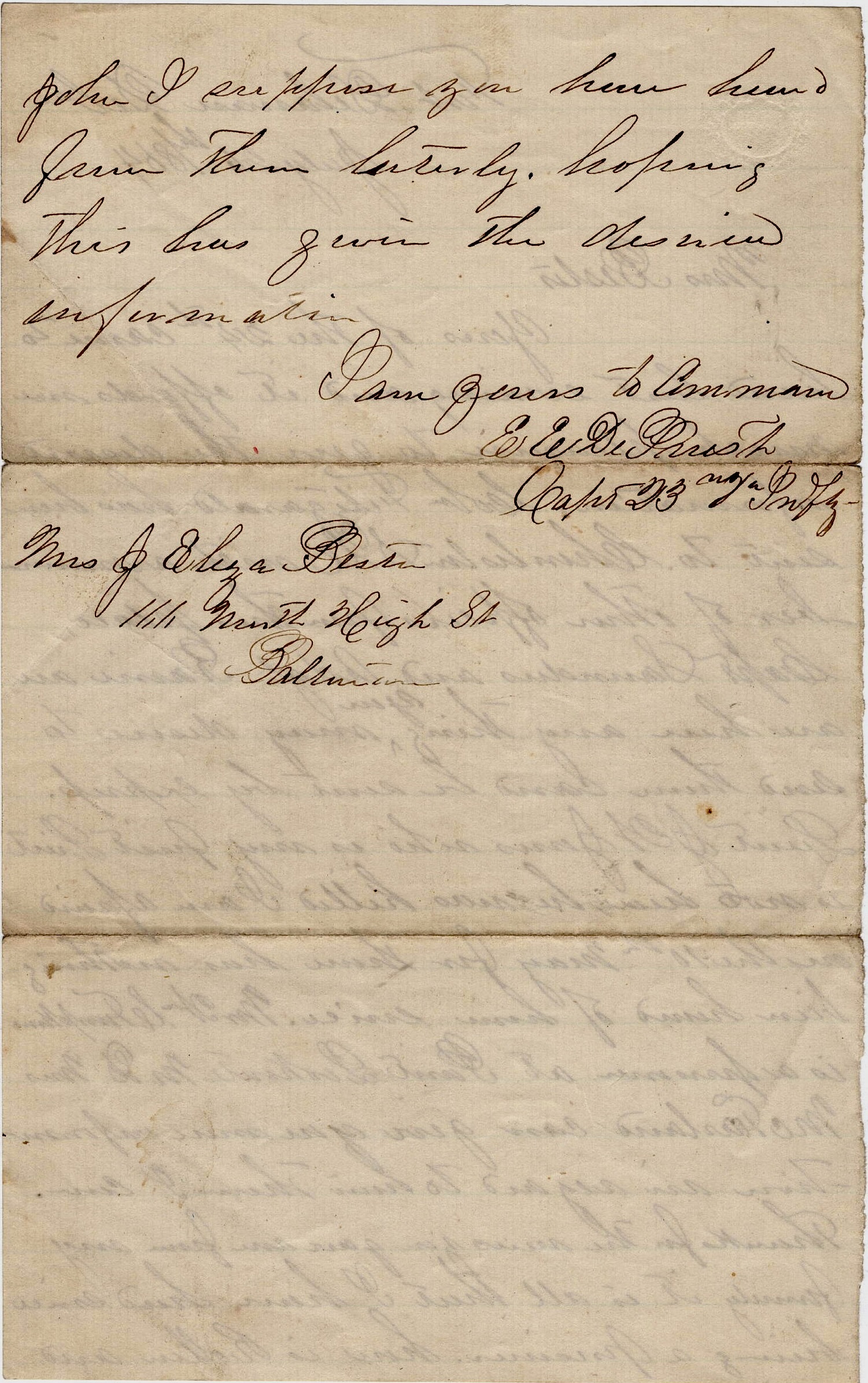
The following letter was written by Capt. Emmet E. DePriest of Co. H, 23rd Virginia Infantry (a.k.a., “The Richmond Sharpshooters”). Emmet began the war as the 3rd Lieutenant of Co. H but “the first three officers listed on the roll were either discharged, resigned, or not reelected. The most junior officer, Emmet E. DePriest, a young, 21 year old, third lieutenant was elected captain in 1862. His service records indicate that he was an able leader but sickly. He was cited for gallantry in 1861 at the action at Carricks Ford (Joslyn 1995:86) but in 1862 he wrote a letter to Confederate Secretary of the Treasury, Christopher Memminger, seeking a job as a clerk due to poor health stating he could not survive another winter campaign (DePriest 1862). He served briefly as a recruiter in 1862, was wounded at the Battle of Chancellorsville in 1863, and suffered from neuralgia in Richmond hospitals in March, 1864.”
“DePriest’s future took a dramatic turn when he was captured at Spotsylvania Court House in May 1864. He was held as a prisoner-of-war at Point Lookout then transferred to Fort Delaware in June 1864 (Joslyn 1995). During his confinement, DePriest was sent to Charleston, South Carolina to be used as a human shield along with other Confederate officers known today as the “Immortal 600″ (Stokes 2013). This action was ordered by Edwin Stanton, Union Secretary of War, in retaliation for Confederate forces placing 600 Union prisoners in the line of Union artillery firing on Charleston. He was then transferred to Fort Pulaski where fellow prisoners died of dysentery. While he was being transferred back to Fort Delaware in March of 1865, he escaped (Joslyn 1995:86).” [Source: The Richmond Sharpshooters, Co. H, 23rd Virginia Infantry]
DePriest wrote the letter to Jane Eliza (Brown) Bestor (1820-1885), the wife of John Rollin Bestor, Sr. (1813-1867). This Baltimore couple had twin sons who served in the Maryland Guard that became Co. B, 21st Virginia Infantry. Eliza seems to have corresponded with numerous Confederate officers seeking information about her sons. The Bestor brothers’ letters have been transcribed and may be found at 1861-65: The Bestor Brothers of Baltimore.
T R A N S C R I P T I O N
Fort Delaware, Delaware July 26th 1864
Mrs. Bestor,
Yours of the 24th came to hand last evening and it affords me much pleasure to give the desired information. Colonel Fitzgerald 1 has been sent to Charleston, South Carolina, with a number of other officers from this place. Capt. Saunders and Adjutant [C. A.] Raine are here. Anything you may desire to send them can be sent by express. Lieut. J. W. Jones who is my 1st Lieutenant is not here. He was killed, I am afraid, on the 10th of May for there has nothing ben heard of him since. Mr. W. C. Tompkins is a prisoner at Point Lookout, Maryland. Mrs. McFarland can give you more information in regard to him than I can. Thanks for the news you gave me from my family. It is all that I have heard since being a prisoner.
How is [your boys] Rollin and John? I suppose you have heard from them lately. Hoping this has given the desired information. I am yours to command, — E. E. DePriest, Capt. 23rd Virginia Infantry
Mrs. J. Eliza Bestor, 166 North High Street, Baltimore
1 Colonel John P. Fitzgerald served in the 23rd Virginia Infantry. The regiment fought primarily under General Thomas “Stonewall” Jackson in the Shenandoah Valley and later as part of the Army of Northern Virginia. He survived a serious wound at Antietam but was captured at the Battle of Spotsylvania Court House and taken to Fort Delaware. He was among the 50 field officers (of a larger number of 600 Confederate officers) selected to be sent to Morris Island to be used as human shields. Fitzgerald survived the ordeal and the war.
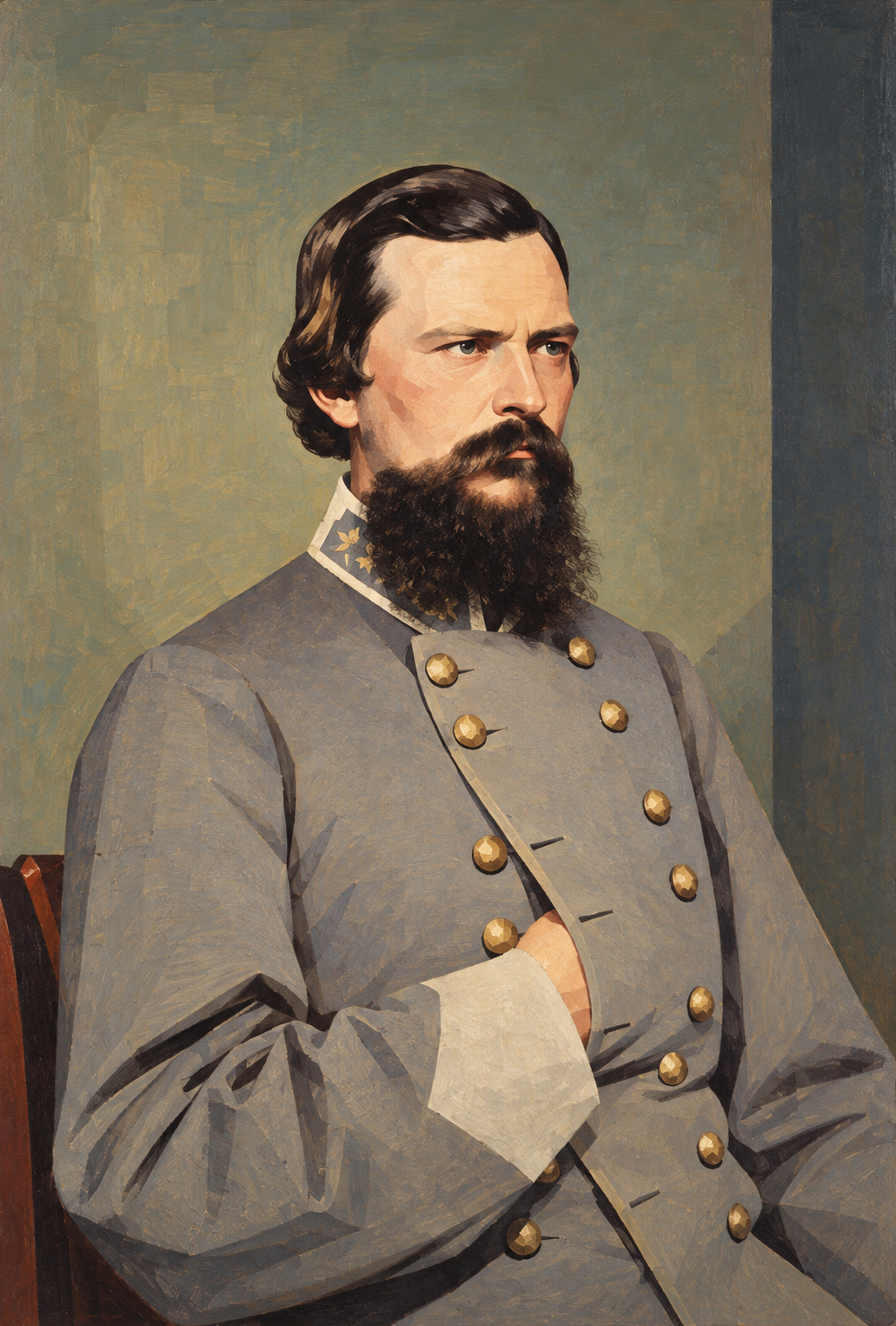
Robert Brank Vance (1828–1899), elder brother of North Carolina Governor Zebulon B. Vance, began his Confederate military service in 1861 by raising a company known as the Buncombe Life Guards and becoming colonel of the 29th North Carolina Infantry. His regiment served in East Tennessee, participated in the defense of Cumberland Gap, and accompanied General Edmund Kirby Smith during the Kentucky Campaign of 1862. At the Battle of Stones River (Murfreesboro) in December 1862, Vance distinguished himself in combat, losing his horse to an artillery shell. His service earned him promotion to brigadier general on March 4, 1863. Following a prolonged illness, he was assigned command of Confederate forces in the mountainous region along the North Carolina–Tennessee border, where he conducted raids against Union supply lines. On January 14, 1864, after capturing a Union wagon train near Knoxville, Vance and most of his command were themselves captured by Federal cavalry.
Following his capture, Vance was held in several Northern prisons, including facilities in Nashville, Louisville, Camp Chase in Ohio, and finally Fort Delaware on Pea Patch Island. During his confinement at Fort Delaware, he was photographed in May 1864 alongside several prominent Confederate prisoners, including Brigadier General Meriwether Jeff Thompson. His eventual release was aided by the Reverend Nathaniel G. Taylor, a Union sympathizer whom Vance had previously held prisoner in Tennessee but had treated kindly and released. Through Taylor’s intervention, President Abraham Lincoln granted Vance a special parole permitting him to purchase clothing and other necessities for fellow Confederate prisoners. In March 1865, Lincoln granted Vance a conditional pardon, allowing him to return home to North Carolina on the condition that he take no further part in the war.
Vance wrote the letters to Jane Eliza (Brown) Bestor (1820-1885), the wife of John Rollin Bestor, Sr. (1813-1867). This Baltimore couple had twin sons who served in the Maryland Guard that became Co. B, 21st Virginia Infantry. Eliza seems to have corresponded with numerous Confederate officers seeking information about her sons. The Bestor brothers’ letters have been transcribed and may be found at 1861-65: The Bestor Brothers of Baltimore.
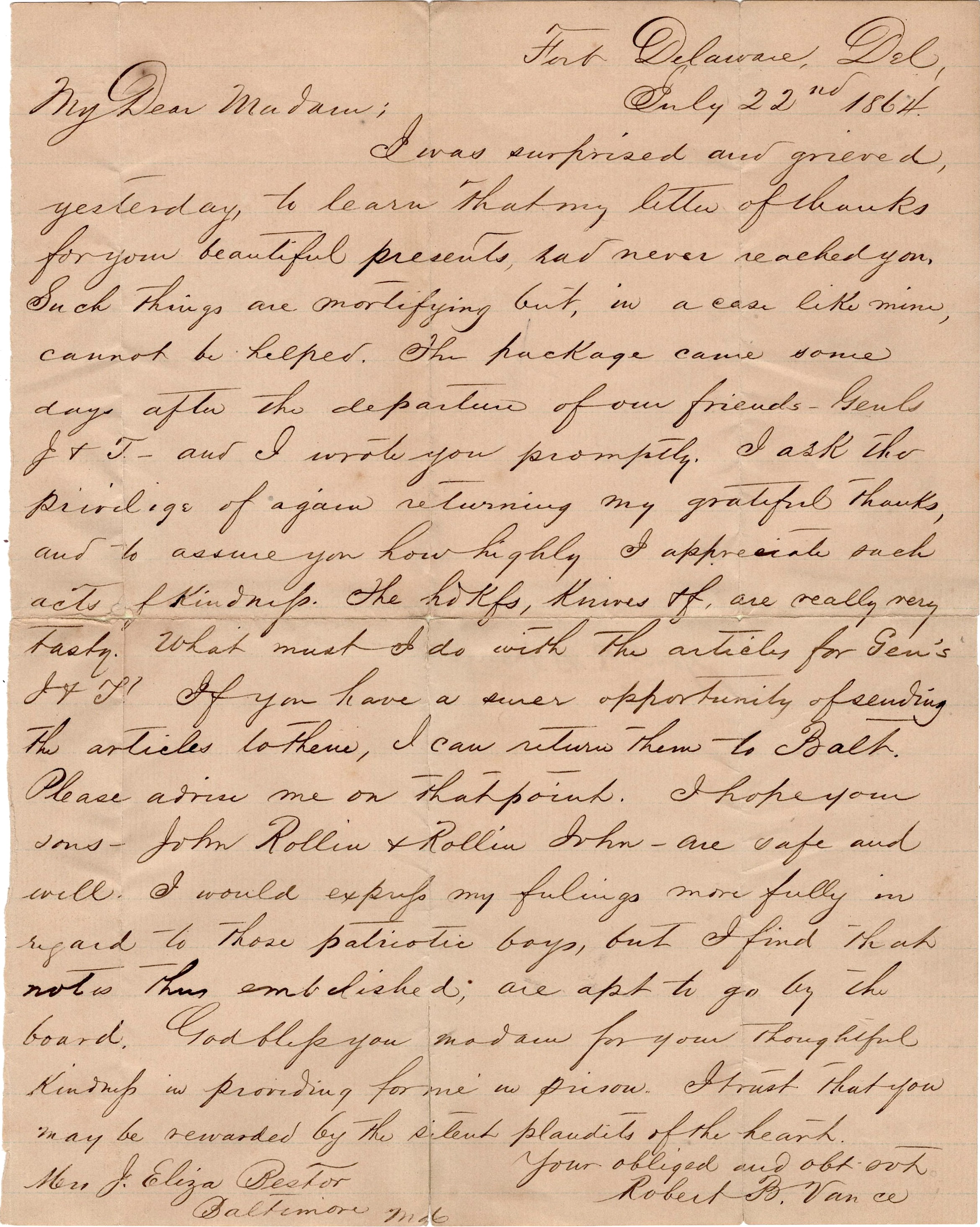
Letter 1
Fort Delaware, Delaware July 22nd 1864
My Dear Madam:
I was surprised and grieved yesterday to learn that my letter of thanks for your beautiful presents had never reached you. Such things are mortifying but, in a case like mine, cannot be helped.
The package came some days after the departure of our friends –Generals J. & T.—and I wrote you promptly. I ask the privilege of again returning my grateful thanks and to assure you how highly I appreciate such acts of kindness. The handkerchiefs, knives & forks are really very tasty. What must I do with the articles for Gen’s J. & T.? If you have a surer opportunity of sending the articles to them, I can return them to Baltimore. Please advise me on that point.
I hope your sons John Rollin & Rollin John are safe and well. I would express my feelings more fully in regard to those patriotic boys, but I find that notes thus embellished are apt to go by the board. God bless you, madam, for your thoughtful kindness in providing for me in prison. I trust that you may be rewarded by the silent plaudits of the heart.
Your obliged and obedient servant, — Robert B. Vance
To Mrs. J. Eliza Bestor, Baltimore, Maryland
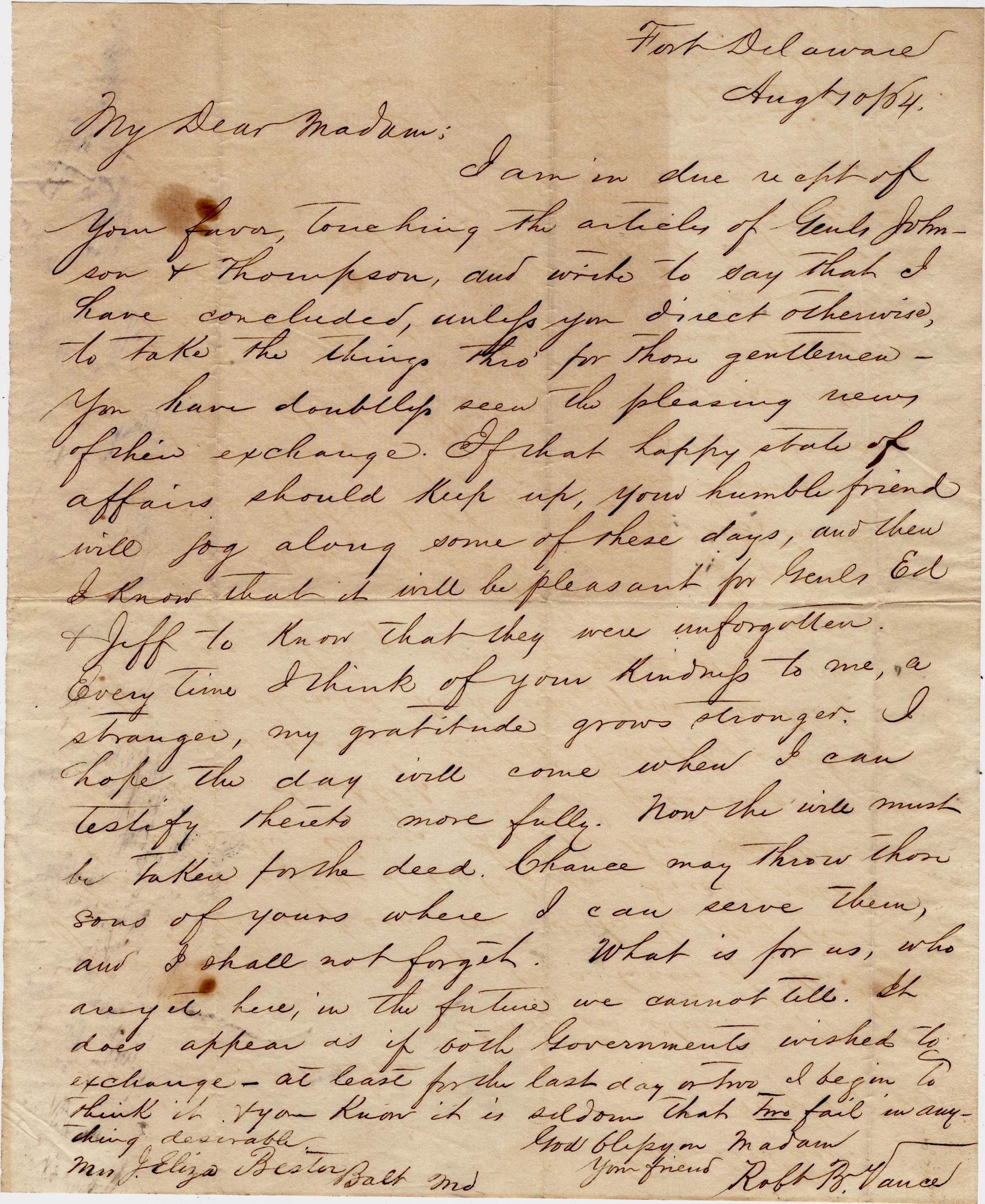
Letter 2
Fort Delaware, Delaware August 10, 1864
My dear Madam,
I am in due receipt of your favor, touching the articles of Genls Johnson & Thompson, and write to say that I have concluded, unless you direct otherwise, to take the things thro’ for those gentlemen. You have doubtless seen the pleasing news of their exchange. If that happy state of affairs should keep up, your humble friend will jog along some of these days, and then I know that it will be pleasant for Genls Ed & Jeff to know that they were unforgotten.
Every time I think of your kindness to me—a stranger—my gratitude grows stronger. I hope the day will come when I can testify thereto more fully. Now the will must be taken for the deed. Chance may throw those sons of yours where I can serve them, and I shall not forget. What is for us, who are yet here, in the future we cannot tell. It does appear as if both Governments wished to exchange—at least for the last day or two. I begin to think it & you know it is seldom that two fail in anything desirable.
God bless you Madam. Your friend, — Robert B. Vance
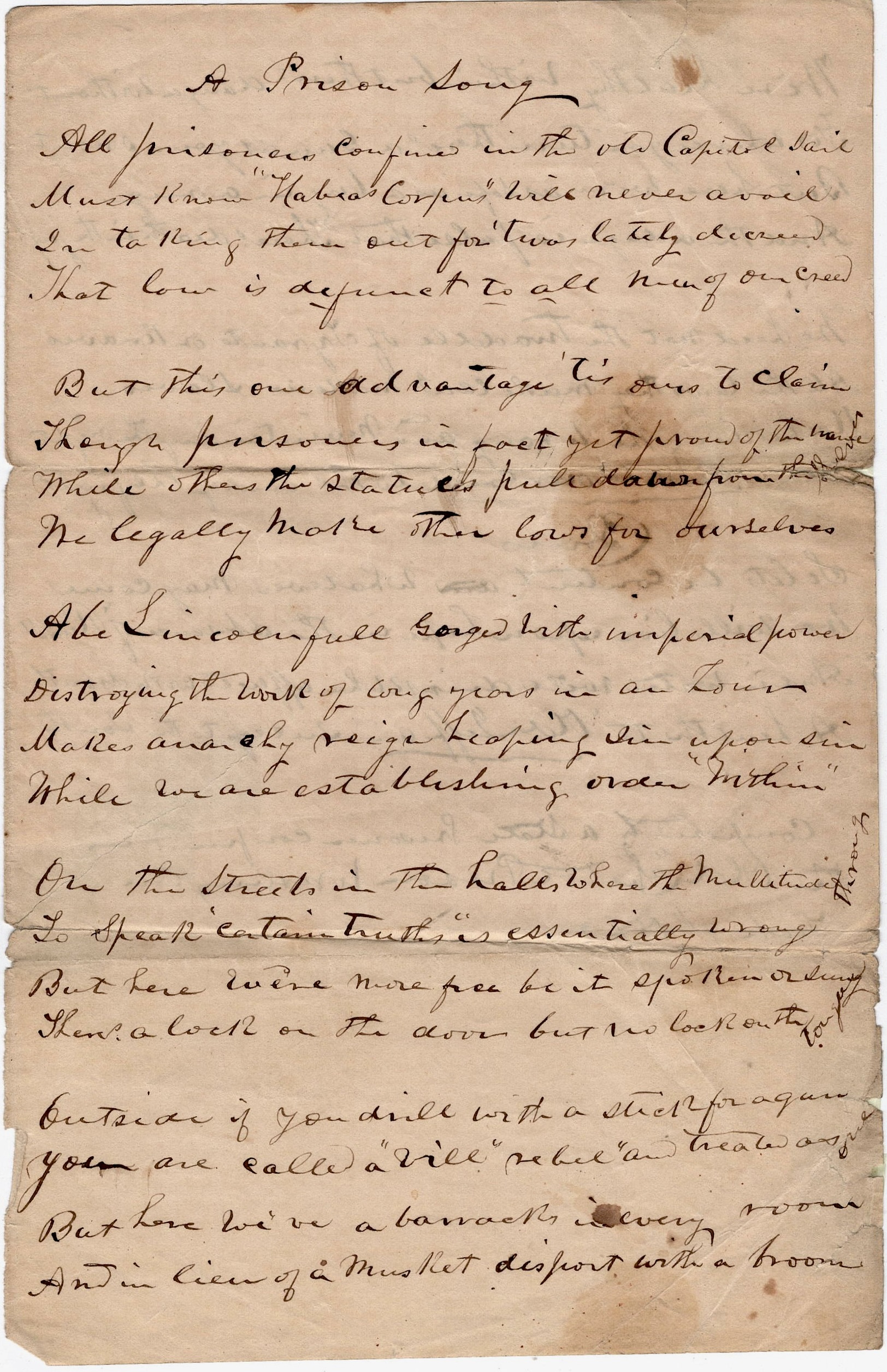
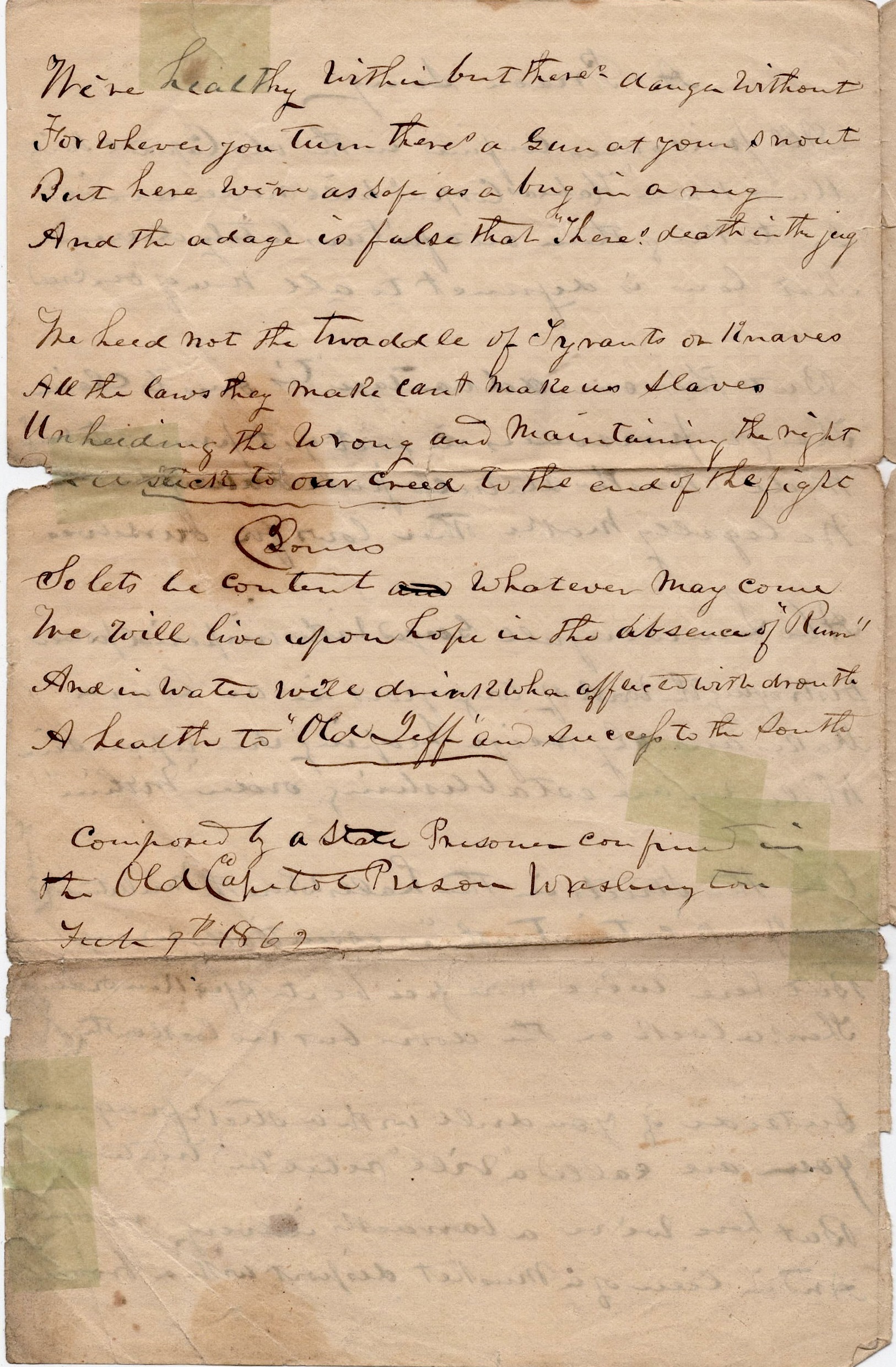
Regrettably there is no signature by the author of this poem entitled “A Prison Song.” Since it contains no strikethroughs or other editing marks, I’m going to conjecture that it was copied from somewhere—perhaps a Baltimore newspaper. If this version was actually handwritten by the author of the poem, it is likely a copy. It was found among the Bestor family papers but I have not yet been able to identify the handwriting.
I searched the internet for a printing of this poem and found it in only one source so far, that being the book published in 1911 by James J. Williamson entitled, Prison Life in the Old Capitol and Reminiscences of the Civil War. It appears on pp. 48-49 in his book with slight variations in the wording and without the final stanza. Curiously the hand written version is actually precisely dated as Feb. 9th 1862. Williamson was not imprisoned in the Old Capitol Prison until 1863 and in introducing it in his book, he states that it had been written before his arrival by someone whose name he did not know.
Because this item was found among the Bestor family papers, I dug deeper suspecting a connection to the family. I discovered that Maria Louisa Bestor (1819-1891) of Harpers Ferry—a relative of the Baltimore Bestors—was married in 1836 to Aaron Amasa Van Camp (1816-1892). Dr. Van Camp was trained in dentistry and when the Civil War broke out, he was practicing dentistry in Washington D. C. He quickly aligned himself with the South, as did many of his Bestor family cousins, and he became a prominent operative in the Rose O’Neal Greenhow Spy Ring. Using his dental office as a cover, he funneled military information across Union lines to Confederate forces. He routinely gathered military information from strategic sources including John Callan, a clerk for the US Senate Military Committee. This spy ring was sniffed out by Allan Pinkerton leading to his arrest and imprisonment in the Old Capitol Prison as a suspected spy, one of his accusers writing that the doctor was “a bitter and dangerous malignant against the government.”
Following his arrest on 31 December 1861, the doctor remained in the Old Capitol Prison until mid March 1862 when he was released after signing an oath of allegiance to the Union. This did not stop him from cooperating with the Confederate Secret Service, however. In 1864, he was discovered to be aiding the Confederacy in the destruction of steamers and foundries in locations between St. Louis and Vicksburg under the guise of being a cotton trader. [Source: Wikipedia]
Given the connection to the Bestor family and the timing of his captivity at the Old Capitol Prison, I’m going to attribute the poem to him but I can’t prove it. Perhaps it was left unsigned intentionally so as to avoid self incrimination as the doctor professed his innocence. He may have been the same “Dr.” whom the Bestor twins credited for having encouraged them to join the Confederate service. See: 1861-65: The Bestor Brothers of Baltimore.
T R A N S C R I P T I O N
A Prison Song
All prisoners confined in the old Capitol jail Must know “Habeas Corpus” will never avail In taking them out for ’twas lately decreed That law is defunct to all men of our creed.
But this one advantage ’tis ours to claim Though prisoners in fact yet proud of the name While others the statues pull down from the shelves We legally make other laws for ourselves.
Abe Lincoln full gorged with imperial power Distroying the worth of long years in an hour Makes anarchy reign heaping sin upon sin While we are establishing order “within.”
On the streets in the halls where the multitude throng To speak certain truths is essentially wrong But here we’re more free be it spoken or sung Here a lock on the door but no lock on the tongue.
Outside if you drill with a stick for a gun You are called a “vile rebel” and treated as one But here we’ve a barracks in every room And in lieu of a musket disport with a broom.
We’re healthy within, but there’s danger without For wherever you turn, there’s a gun at your snout, But here we’re as safe as a bug in a rug And the adage is false that “There’s death in the jug.”
We need not the twaddle of Tyrants or knaves All the laws they make, can’t make us slaves Unheeding the wrong and maintaining the right, We’ll stick to our creed to the end of the fight.
So lets be content, whatever may come, We will live upon hope in the absence of “Rum.” And in water we’ll drink, when afflicted with drouth A health to Old Jeff’ and success to the South.
Composed by a State Prisoner confined in the Old Capitol Prison Washington Feb 9th 1862
The following letter pertains to the search for the body of Lt. Hugh Jones Gaston (1836-1862) of the 48th North Carolina Infantry who was wounded in the shoulder and face and captured in action in the West Woods at the Battle of Sharpsburg on 17 September 1862. It would be his first and last battle. He was paroled on 26 September 1862 but died of his wounds about 15 October 1862, probably at a field hospital near the battlefield.
Gaston graduated from Georgetown University in 1855 and was licensed to practice law in 1857. He was in Memphis when the war erupted and served as a private in a Tennessee artillery company before returning to North Carolina, accepting a commission as 1st Lt. and serving as the adjutant of the 48th N. C. Infantry. His Find-A-Grave memorial places his death at Hagerstown and speculates that he was buried in the Washington Confederate Cemetery there.
This letter suggests that Lt. Gaston may have been in a field hospital near Sharpsburg on the property of Peter Grove but I am unable it identity anyone by that name residing there at the time of the battle. The writer may have been referring to the property of Stephen P. Grove near Sharpsburg which was used as a hospital. Neither could I find a Peter Grove living near Hagerstown at the time.
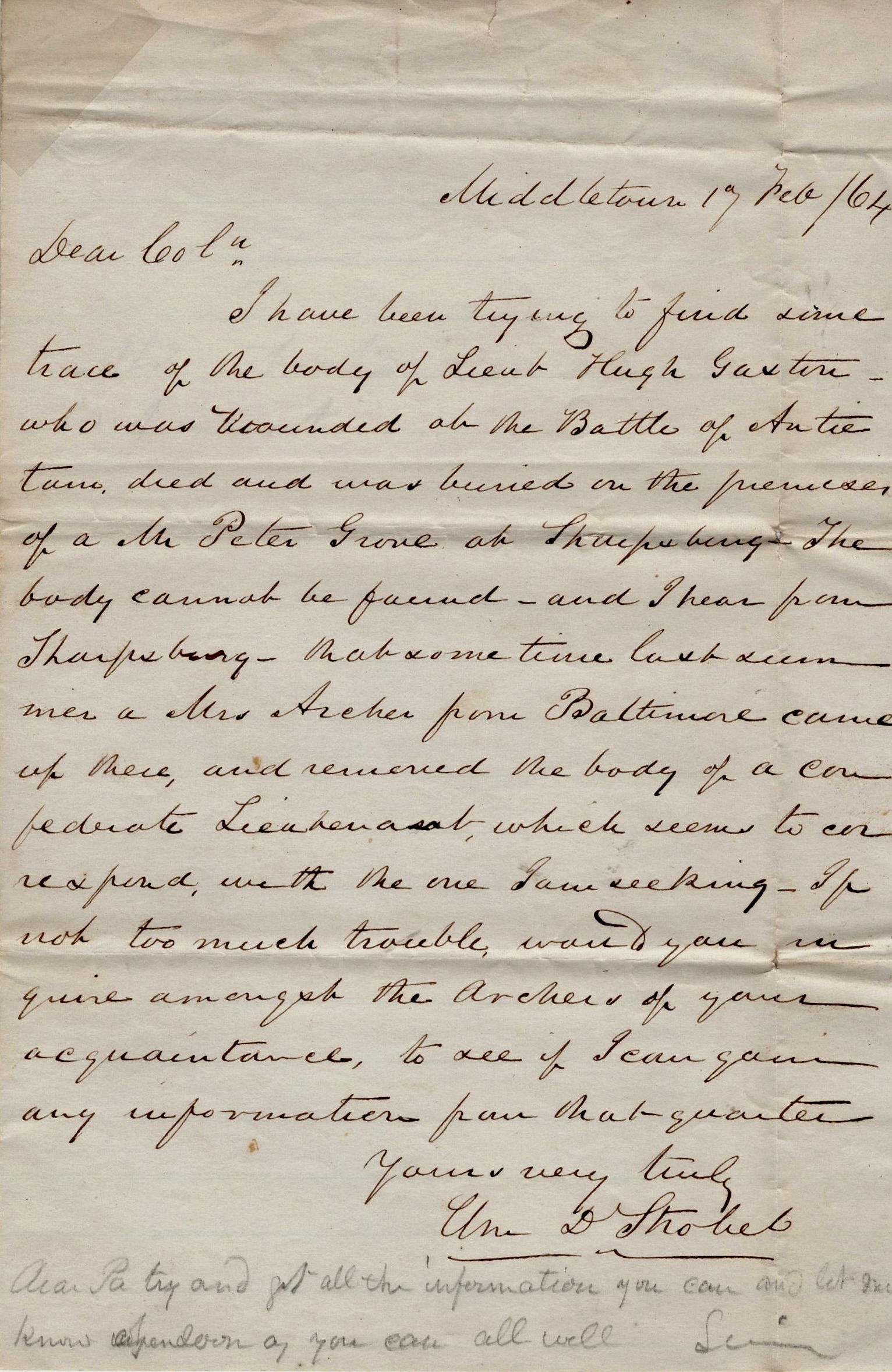
This letter was written by Rev. William Daniel Strobel (1809-1884) who held a Doctor of Divinity and began his missionary work in South Carolina. He was later affiliated with the Maryland Tract Society in Baltimore. He was serving as the pastor of the Zion Lutheran Church in Middletown, Maryland, from 10 April 1863 through June 1867. It was said of him that his “true Christian charity and forbearance in the midst of the alienations produced by divergent political views held the congregation together” during the Civil War.
T R A N S C R I P T I O N
Middletown [Maryland] 17 February 1864
Dear Col.
I have been trying to find some trace of the body of Lieut. Hugh Gaston who was wounded at the Battle of Antietam, died and was buried on the premises of a Mr. Peter Grove at Sharpsburg. The body cannot be found, and I hear from Sharpsburg that some time last summer, a Mrs. Archer from Baltimore came up there and removed the body of Confederate Lieutenant, which seems to correspond with the one I am seeking. If not too much trouble, would you inquire amongst the Archers of your acquaintance to see if I can gain any information from that quarter.